

Source : the age
If you could clone yourself, would you? It’s this question that lies at the heart of Chenturan Aran’s new show, The Supposed To Be.
“I think that’s a mental game that a lot of people play; maybe it’s more severe if you’re a second-generation Australian? You’re always thinking about these two binary cultural experiences and worlds,” Aran says.
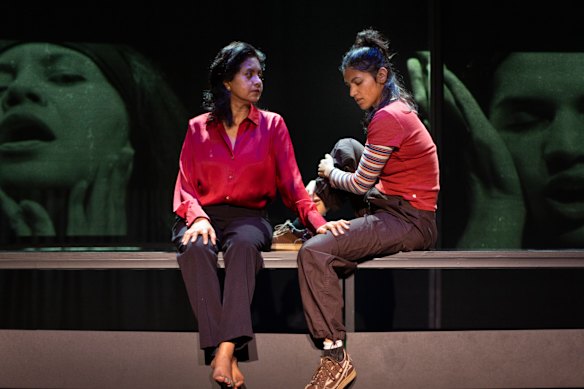
Staged at Footscray Community Arts as part of the Rising festival, Kavitha (Michelle Perera) is a corporate executive embodying the conventions of the model migrant archetype, while her dead ringer Kaye (Sarah Fitzgerald) channels her fantasy lifestyle as a Sri Lankan Tamil actor and OnlyFans star.
The show pushes against the idea of the authentic identity being purely tied to a cultural or ancestral connection, but rather a multidimensional spectrum of personal interests and influences.
Aran cites his own inspiration as the irreverent humour and melodrama found in Pedro Almodóvar’s films, the surrealist storytelling in Charlie Kaufman’s Adaptation and Eternal Sunshine of a Spotless Mind as well as Ingmar Bergman’s Persona, a psychological drama about a nurse and patient who begin to merge identities.
“We have to become these translators for a population that hasn’t had their stories told in the Australian landscape, but that’s not really an exhaustive or full picture,” Aran says. “We all have hobbies, different experiences and also curiosities; things that we want to learn about.”
The sterility of the sci-fi context provided the perfect backdrop for portraying how ancestral connections become untethered as communities become more globalised. The compulsion to escape the restrictiveness of a migrant upbringing and community expectations is also one of the play’s focuses.
“A lot of my writing is kind of based on how my family interacts. There’s an irreverence, invasiveness and a sudden move into melodrama with Sri Lankan Tamil parents – you go f—ing Sun TV [a cable channel known for heightened Tamil soap operas] real quick,” Aran says with a laugh.
Green Room award-nominated actor Perera finds it cathartic performing the relatable moments reflecting her Sri Lankan upbringing. “In South Asian cultures, we’re not prone to actually say the words, ‘I love you’, but it is shown in many different ways,” she says. “Whether it’s constantly feeding someone or just shouting at them, there is cruelty masked as love. The West doesn’t understand that.”
Aran says: “There’s a bit of a celebration of that intensity, that yelling. You don’t want to become all waspy.”
‘All the boundaries are blurred. What is a performance and what is your real life?’
Isabella Vadiveloo, director
Director Isabella Vadiveloo and Aran have been working on the script development and dramaturgy since 2023. “When I’m directing something with sci-fi components, I only ever approach it as a human story that transcends the genre. But the genre gives us a familiar and exciting new lens to explore those aspects of connection and culture,” Vadiveloo says.
The mutual trust Vadiveloo and Aran share forges a strong creative partnership, ripe for risk taking and tackling complex themes and deeply considered storytelling. Aran also worked Perera’s life experiences into the script, including her upbringing in Sri Lanka and family dynamics; she commends his aptitude for writing women.
“All the boundaries are blurred,” Vadiveloo says. “What is a performance and what is your real life? What is your cultural expectation and what [are] your personal wants? All of those things, they meld and blend.”
Perera adds: “You start off speaking about it theoretically – ‘Oh, I’m helping the script.’ But then you realise, ‘My goodness, these are conversations that I needed to have’, you know?”
Aran says there is still industry pressure to tell South Asian theatre work with a cultural lens, that it needs to stem from your parents’ life story or translated for mainstream consumption. It’s rare, Vadiveloo says, for multiple works by South Asian writers or directors to be staged in a theatre season to explore the multiplicity of ideas and genres.
“The assumed audience still always has to be white people,” she says. “So, as we’ve become more progressive in who we can show, we’ve become more conservative in what we can show those people doing.”
Vadiveloo and Aran insist their show is a comedy, and that the freedom to laugh is part of healing and important to find joy among drama.
But, when it comes to having a second chance at life, is an alternative path as tantalising once you’ve been slapped with the cold hard truth of reality? This is the crux of what Kavitha discovers when she finally meets Kaye.
“Part of the play is that this perfectionism Kavitha has for her clone can only exist in her mind, and that the clone isn’t actually as happy as she thought they were,” Aran says.
The Supposed To Be is at Footscray Community Arts from May 27 to June 6 as part of Rising