

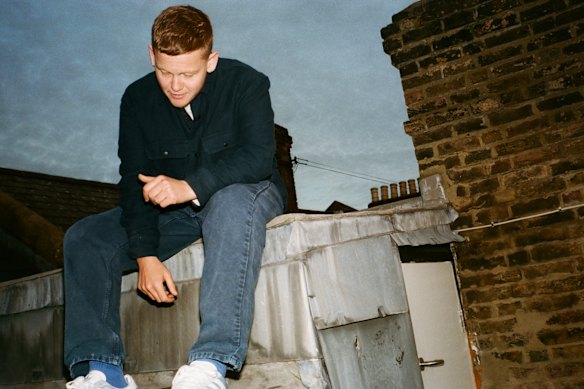
Source : the age
Words are Kae Tempest’s way through. On record, they flow like water purified from grey matter to crystal clarity. In the London writer-performer’s second novel, Having Spent Life Seeking, they transform lives of intense turmoil into order: darkness insisting on a new day.
Even kicking back at home, echoes of recent departure and arrivals halls still ringing, a morning talking to strangers is more opportunity than chore. “I love talking to journalists about things I haven’t even spoken about to friends I’ve had for 30 years,” he says, eyes alight behind round glasses.
But “it’s a weird feeling”, he concedes. “You go so fast. You meet someone for a minute, and you’re talking about death” – and suddenly, you’re talking to someone else. “It’s like emotional jet lag or something.”
Tempest’s words invite a shortcut to the heart of things, past the language we often use to obscure it. His fifth album, Self-Titled, and the new novel both engage vividly with trans experience, social expectation and the consequences of being read and misread by the world.
The lauded poet, playwright and rapper came out in 2020 and has since spoken publicly about his transition. “Maybe it’s useful to just say, we’re just people,” he says, opting for the poet’s economy rather than repeating himself. “We’ve got different experiences of our bodies, and we’ve got something valuable to share about that.”
Tempest’s 2013 Ted Hughes Award for Innovation in Poetry confirmed a skill for making lived experience not just lyrical but enlightening. Brand New Ancients, the hour-long spoken story that earned it, placed ordinary South London lives on an epic footing, blurring theatre, poetry and performance.
From open-mic readings as a teen to dramatic commissions from the Royal Shakespeare Company and the National Theatre, the forms keep multiplying, but the drive has stayed the same: to take what’s felt privately and make it ring loud and clear.
“There’s definitely a kinship,” he says, between the new album and novel, “Because they came out of the same time … so there’s a shared wellspring of feeling running through both. But an album exists in this world. There’s an openness to it, a flow … a novel has to happen in a different world.
“You have to build that world, and it has to have as many rules, consistencies and inconsistencies as this one. You have to test everything. Every board in the floor has to hold the weight of a character walking across it … You’re on this journey of discovery, looking and looking, and it’s not until late in the process that you realise what it is you’re looking for.”
The character of Rothko in Having Spent Life Seeking is an ironic reflection of the author. We meet them teetering on a ladder in a windstorm, fresh out of jail, living in a van, “maintaining their existence one menial chore at a time” and ill-equipped to verbalise any of it. For a writer whose work is defined by precision of language, it’s a striking choice.
“I identify with Rothko’s state of overwhelm,” Tempest says. “They’re constantly overwhelmed, both by the beauty and by the difficulty of experience. Language is tough. They’re not fluent in that way, but they’re fluent in different ways of expression.
“All the characters in the novel are dealing with some state where they can’t quite express their authentic self out loud. There are these moments where suddenly they are seen by someone who understands them and holds them. They can be really simple moments, but suddenly quite powerful.
“We understand ourselves through relating,” Tempest says. “It’s in practice that we learn who we are. It’s one thing to feel a sense of becoming, but it’s when you’re becoming in community that you really start to live.”
Hip-hop tends to offer a more direct line of sight between author and community. Tempest has always moved between voices on record, building characters and shifting perspectives, but on Self-Titled that voice feels closer than ever to the body it comes from. It was producer Fraser T Smith (Adele, Stormzy), who nudged him there. “He said to me, ‘Who else alive can tell your story? Why are you shying away from telling it?’ I don’t know if I would have given myself access to that.”

“I’ve been dragging a bag of shame that’s bigger than me,” he raps in Know Yourself, which flashes back to the revelation of his first Wu-Tang Clan gig to offer “peace to the kid I came after”. Elsewhere, two lines flip a past of self-loathing into a classic hip-hop flex: “They never wanted people like me round here/ But when I’m dead they’ll put my statue in the square.”
“There’s a long tradition in hip-hop of speaking your truth,” he says, “Telling your story, explaining your situation, talking from the heart. That always felt really vital to me; that direct access to the internal world of a stranger.”
As a neurodivergent person, he didn’t understand social interaction. “It often felt insubstantial. But I’d listen to a lyric, to a rapper I love, and I understood what that was: something from the heart. It could take me to a place of authenticity in terms of how I engaged.”
It’s that connection that keeps his fans coming back. Tempest’s June shows will mark his fourth visit to Australia, in settings which tend to be more musically rich than the hip-hop default.
“I have huge respect for two turntables and a microphone. I love a DJ and MC set. But personally, I need the music to be happening. I need the conjuring to be a mutual, live feeling.” Hence Pops Roberts, the Manchester musician who triple-tasks on beats, keys and vocals on this tour.
“The music’s changed. The show’s changed. The presentation of the spirit of the piece has changed. That’s the way that I think about performances and touring: it’s always developing, and every time I do a show I’m learning something about what a show is and could be.”
The learning cuts both ways, as the intensity of Tempest’s experience finds its form in words. “Big bunch of letters between U and I,” he quips in Diagnoses. He’s talking about the complex language of neurodivergence, but the point carries into the language that gathers around gender identity. “It’s actually beautiful that we can offer our understanding of something that is as profoundly important to so many people as their gender,” he says, as our conversation races towards another abrupt interruption.
“You know, I don’t know you, but I take it that you feel successful and comfortable in what I perceive to be your manhood. And that means that you can live in a grounded sense of a body and a person and a self. It’s not that case for everybody.
“But there’s something else that we know about masculinity, femininity and everything in between … and how wonderful that we live in a time and a place where we can even be having this conversation out loud. How wonderful. How beautiful. There’s so much we don’t know. There’s so much to learn.”
Kae Tempest plays the Melbourne Town Hall for the Rising Festival on June 6, and City Recital Hall for Sydney’s Vivid Festival on June 9 and 10. Having Spent Life Seeking (Jonathan Cape) is out now.
Get the day’s breaking news, entertainment ideas and a long read to enjoy. Sign up to receive our Evening Edition newsletter.