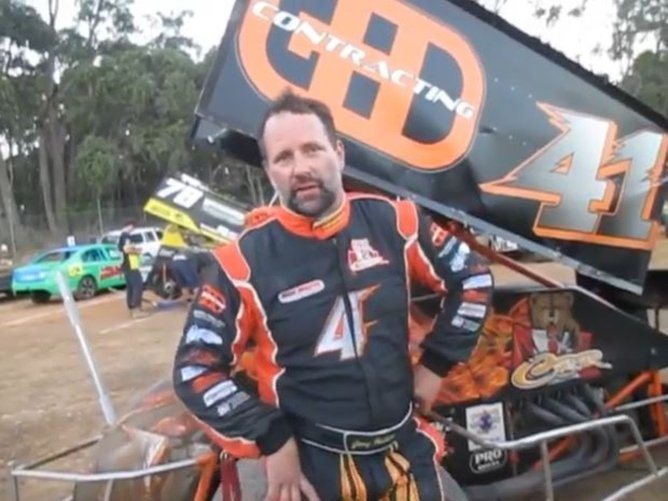
Source : Perth Now news
A coronial finding into the deaths of two racers who died racing in the 2022 Rainbow Desert Enduro has called for urgent fire safety changes across off-road motorsport, warning lives remain at risk unless tougher rules are brought in far sooner.
Victorian Coroner Ingrid Giles found Gerald “Gerry” Hoekstra, 46, and Ede Taric, 50, survived the crash that overturned their buggy near Rainbow in Victoria’s northwest, but died in the fire that followed when spilt fuel ignited.
Her findings reconstruct a horrifying sequence on September 4, 2022.
Mr Hoekstra and Mr Taric were racing in a modified 2021 Can-Am Maverick X3 side-by-side buggy, capable of reaching 130km/h, when they entered a narrow, greasy stretch of farmland track near Fuller Rd.
Witnesses had already identified the section as one of the most dangerous parts of the course. A spectator familiar with local racing said several vehicles had clipped trees at the same bend the previous day.
By Sunday morning, Mr Hoekstra’s buggy approached the chicane, a tight series of bends, at about 122km/h.
One witness said it “didn’t slow at all” before striking a tree in what was described as a violent 12G impact.
The vehicle rolled onto its side, blocked the track and caught fire within seconds before two rival teams stopped almost immediately and tried to save the men.
Competitors Mark Foster and Cameron Polan were among the first to reach the burning buggy, joined by Alexandra Howells and navigator Sarah Corrigan.
They emptied six one-kilogram handheld fire extinguishers into the flames, but the fire was already being fed by fuel and could not be controlled.
Mr Polan’s extinguisher “basically did nothing”, according to the report.
In the chaos, there were signs that Mr Hoekstra was still fighting to escape.
Witnesses saw that he had managed to “fling” open the driver’s side window net and get his head and shoulders out of the vehicle, but he could not free himself.
Others tried to pull him clear, but the fire, the vehicle’s position and his injuries made that impossible. Mr Taric was also trapped.

Rainbow CFA members arrived about 12 to 13 minutes after the crash and extinguished the blaze, but by then both men had died.
Autopsies found soot in both men’s airways, confirming they were alive when the fire began.
Mr Hoekstra had fractures to both lower legs, while Mr Taric had a fractured right thigh, injuries that left them unable to escape the burning wreckage.
Ms Giles found the fire was most likely sparked when heat from the buggy’s catalytic converter ignited fuel spilt during the crash.
A Victoria Police Arson Chemist found one auxiliary fuel tank had a plastic cap and filler neck protruding beyond the safety cage, leaving it vulnerable to impact damage.
In the crash, the cap detached and fuel escaped freely because the filler neck lacked a reflux valve.
“Had a reflux valve been present, the fire would have most likely been prevented, in that the fuel would not have spilt freely from the tank,” Ms Giles said.
A key finding is that the buggy complied with the rules in force at the time but the coroner concluded those standards were not good enough for the real-world conditions of off-road racing, where a crash can quickly become an inescapable fuel-fed fire.

The handheld extinguishers mandated under the rules were found to be inadequate. The blaze could not be brought under control until firefighters arrived, and Ms Giles said a plumbed-in extinguisher system inside the vehicle might have bought the men crucial extra time.
The finding also examined whether the men could have escaped had conditions been different.
Motorsport Australia’s rules said vehicles had to be designed so crews could exit within 10 seconds, but Coroner Giles noted that there was no requirement to prove drivers and navigators could actually get themselves out quickly in an emergency.
Since the deaths, Motorsport Australia has made several changes. It now requires reflux valves in fuel tanks, bans structures that protrude outside the safety cage, and has doubled the required capacity of handheld extinguishers at off-road events.
It has also started a staged rollout of mandatory plumbed-in fire suppression systems.
But Ms Giles said that reform is still too slow.
She recommended that all off-road vehicles in sanctioned events be fitted with plumbed-in fire extinguisher systems by the end of the 2026 racing season, and that all competitors be tested before races to prove they can self-extricate within 10 seconds.
She also said organisers should face clearer requirements for firefighting resources, including whether dedicated mobile fire units should be stationed on site.

Mr Hoekstra, a Tasmanian father of seven, was remembered by his wife Deborah as a devoted family man.
“Hard worker, he was motivated and he put everyone else before himself …. Gerry was an amazing, amazing man,” she said.
Though he had raced sprint cars for two decades, she had always feared the buggy, stating she “hated the vehicle” and had an “awful feeling” about it.
Before Rainbow, he asked if he could do “just one more buggy race which was in Rainbow”.
“I didn’t like it but I said OK,” Deborah said.
Mr Taric, a Serbian migrant who arrived in Australia in 2004 and became a citizen in 2007, was described by his partner Juanita Wilkinson as a “gentleman” who “was very intelligent and always seemed to be two steps ahead of everyone else”.
“He taught himself English and was the type of person that when he set his mind on achieving something, nothing would stop him from doing it,” Ms Wilkinson said.
After recently battling lymphoma, she had encouraged him to embrace life.
The coronial recommendations are directed not only to Motorsport Australia but also to the Australian Auto-Sport Alliance, pushing both governing bodies to act before another off-road fire turns fatal.