Source : the age
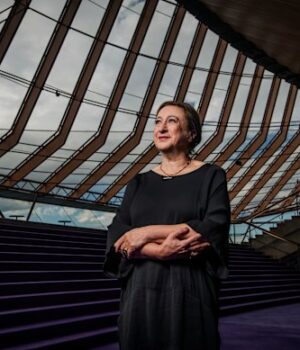
For a conductor known for the fearsomely intellectual rigour and depth with which she approaches every score, Simone Young has an unusual message for those attending Sydney Symphony Orchestra’s performance of Mahler’s Seventh Symphony.
Don’t overthink it.
“Don’t try to pull it apart. Don’t try to make sense of it. Don’t try to think this means that and that means this, therefore this is… Just sink into the colours. Let it take you over.”
For the SSO’s chief conductor, the 2027 season opener demands more than just attentive listening. It will be a visceral, physical encounter in the Sydney Opera House Concert Hall, enveloping players and listeners alike.
And at a time when artificial intelligence can now analyse, reproduce or simulate practically anything, Young regards the shared experience as irreducibly human and the concert hall as a redoubt that can never be breached by AI.
“It might be able to be replicated, but it can’t be experienced in the same way,” she says. “There is something that is deeply human about being part of a community experience in a concert hall. Being part of that sound. The moment you are physically within the space, you are part of the sound. And there’s just something immensely human about that that AI can’t do.”
Next year will be the SSO’s 95th anniversary as well as Young’s sixth season as chief conductor. In that time, the relationship between conductor and players has only deepened and matured.
“We’re growing together in a way that is interesting,” she says. “I have to talk to them less now than I did five years ago. There’s so much more we just understand about one another.”
Young, who splits her time between Australia and Europe, also identifies a uniquely Australian fearlessness in the SSO players’ approach.
“I love that fearlessness, that courage to explore, that desire to be curious about what we are doing. I want to encourage that as much as I possibly can.”
Young says the acoustics of the renovated Concert Hall, which re-opened in 2022 with her conducting Mahler’s monumental Second Symphony (the Resurrection), allow the SSO players to be ever bolder.
“The clarity at the bass end of the sound means there’s a whole new world of articulation out there that they can play with,” she says. “I can demand from them much more variation in dynamics.”
Her multi-year presentation of the Ring Cycle concludes in November with Götterdämmerung. Young has pondered: where to go after Wagner’s masterwork?
The answer is a concert performance of Richard Strauss’s opera Salome, with which she is intimately familiar, having conducted it some 50 times over the past 30 years. It will form the bookend to the Mahler concerts.
At a compact 100 minutes, Salome makes up for its brevity (relative to Wagner at least) with the extravagant orchestration demanded by Strauss.
“I don’t think Sydney has ever heard Salome in its full orchestral magnificence.”
Simone Young
“I don’t think Sydney has ever heard Salome in its full orchestral magnificence because the opera pit [in the Joan Sutherland Theatre] certainly can’t house it,” says Young. “We’re doing it in the original orchestration with God knows how many clarinets, and the harps and the celesta. All the bells and whistles.”
There will also be a heckelphone – Young will insist on it. A rare double-reed instrument, akin to a bassoon, the heckelphone was invented at Wagner’s behest and often used by Strauss.
“And any great Strauss work has a heckelphone. It adds a particular [musical] colour,” says Young.
Next year is the 200th anniversary of the death of Beethoven and to mark the occasion, Young will lead the SSO in a two-week festival giving audiences the rare opportunity to hear his nine symphonies played in chronological order.
“The idea of doing a Beethoven cycle was too appealing to lose because it’s the sort of thing you can only do for an anniversary year or a special event,” she says. “I’m enough of a realist to believe no one has much more to say about a Beethoven Five or Seven but to stick a Beethoven Five immediately after a Beethoven Four and know you’re coming back to hear a Beethoven Six next week puts it in a chronological perspective you seldom have the chance to experience. It’s like reading all the Harry Potter novels in the right order.
“So, to see the compositional development of the man, to witness the progressive deafness and the progressive experimenting and harmonic structures and the expanse of the symphonic structure … I expect personally to win a greater understanding of the symphonies. And I expect the orchestra and the audience to do the same.”
Five years into a tenure that has been extended to the end of 2029, Young says working with the SSO still feels “incredibly fresh”.
“I’m looking ahead and thinking how exciting it is about all the things we can still do together. Instead of thinking about [where do I go after five seasons?], I’m immensely happy in the relationship with the orchestra, and I think the orchestra’s just getting better and better.”
For the full 2027 season, go to www.sydneysymphony.com