SOURCE :- THE AGE NEWS
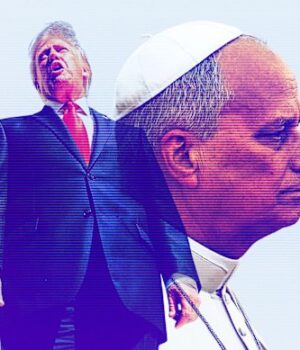
Rome: The deadline is set for a decision in the White House on technology that promises – or threatens – seismic change to the way humanity lives and works. Donald Trump wants advice within 120 days from a new task force on artificial intelligence that is under orders to ensure America dominates the field in a race against China.
“We will not in any way hinder or stifle the Growth of this incredible Industry,” the US president declared last month. His latest move came last Sunday, when he named former spy boss Jay Clayton to lead the White House’s new “Super Intelligence Force” and report on AI risks and opportunities. Nobody is in any doubt that the president wants a road map that highlights the sunny vistas ahead, rather than the chasms beside the highway.
One man, however, is seeking to avert what he fears could be a robotic future that weakens what it means to be human. Pope Leo XIV, a graduate in both mathematics and church law, has emerged this year as one of the leading global critics of the rush towards digital models that leap ahead of human thought.
The deeper argument is about much more than Trump and the tech bros of the AI business. Pope Leo is wielding the soft power of the Vatican at a time of growing unrest in the world and distrust in political leaders. Whether the issue is war, migration, poverty or faith, he presents a worldview at odds with those who wield hard power.
“New forms of slavery are fuelled by economic chains and digital infrastructures,” the Pope says in his analysis of AI. This warning about slavery is a constant theme in the 42,000-word papal encyclical on the issue, which peppers its theology with quotes from authors ranging from J.R.R. Tolkien to Hannah Arendt.
“If technology becomes the ultimate criterion, the human person risks being reduced to data, a cog in a machine or a commodity,” the Pope says. “If, however, technology is integrated with a wise perspective, it can become an instrument of growth, justice and fraternity.”
This is not a call to halt new forms of computation or slow progress. It is an argument to keep humanity in charge and ensure people share the benefits. And the Pope is making sure political leaders hear his warning. On Wednesday, for example, Prime Minister Anthony Albanese met the papal envoy on AI, Father Paolo Benanti. They appeared to agree on the problem.
Trump’s allies see a conspiracy at work with this new Pope. Steve Bannon, the strategist of the MAGA movement and a conservative Catholic, declared last year that the central authority at the Vatican – the Roman Curia made up of cardinals and others in key ministerial positions – wanted a leader who would defy the White House.
He called the election of Pope Leo the “worst choice for MAGA Catholics” because it blocked their influence. The outcome of the conclave, he told Politico, was an “anti-Trump vote by the globalists of the Curia”.
This view has shaped the debate over Pope Leo in conservative politics ever since, although it was hardly a surprise from Bannon. He railed against the former pontiff, Pope Francis, too, for being too left-wing.
Conspiracy theories aside, the friction between the Vatican and the White House has shaped the coverage of the AI debate.
When US Vice President JD Vance argued in March last year that there was an “order” to Christian love that placed a priority on family before others, Pope Leo corrected him. “JD Vance is wrong: Jesus does not ask us to rate our love for others,” he said. They have spoken since; Vance said in June they had a “positive” relationship.
When Trump fumed at the pontiff for opposing the war on Iran and declared him to be “weak on crime”, the response was firm. “I have no fear, neither of the Trump administration, nor of speaking out loudly about the message of the Gospel. And that’s what I believe I am called here to do,” Pope Leo said in April.
When US Defence Secretary Pete Hegseth suggested that God was on America’s side in the war in the Middle East, the Pope warned in April against using Jesus to justify conflict, although he did not name anyone in the US administration.
Only two weeks ago, the same contrast was apparent when journalists on board the papal plane to France asked Pope Leo about Trump’s decision to ban CNN and other reporters from the White House. The Pope declared he was “very happy” with journalists covering his work. “You are all welcome,” he added.
While Trump dismissed the recent warnings from tech company whistleblowers about the risk that AI could destroy humanity, the Pope offered a totally different view. “If someone were to ask me, am I in panic mode? No, I am not,” he told reporters on September 28. “I sleep at night. I do think that the concerns raised by many of the experts, specialists in AI, should be taken seriously. I do not think that is fake news, as some have said, to try and cause financial or some other kind of benefit.”
This is not just a contrast with one world leader. The (relatively) new pontiff offers a counterpoint to all those who trade in material gain and earthly power. It is, after all, his mission to spread a moral, ethical and spiritual message.
“He has a quiet charisma,” says Kristina Millare, a freelance journalist who has worked in and around the Vatican and seen the new pontiff interact with the press pack. “He’s very calm, he’s very candid. He’s not trying to make a show, which is what people see from political leaders and the tech giants.”
The Catholic Church may struggle to assert its moral authority, of course, when it has been the subject of scandal over many years. Whether the issue is sexual abuse by Catholic clergy and the protection they gained from church leaders, or murky dealings in Vatican finances, the questions about the past can undermine the attempts in Rome to influence the future.
Even so, the soft power of the papacy is real in a world with 1.4 billion people who follow the Catholic faith. This week, it was visible in the support from pilgrims in St Peter’s Square when the Pope held a general audience on Wednesday morning: thousands queued at security checkpoints to enter the square and hear his remarks.
One of his messages on Wednesday was that Christians should practice what they preach. “The discrepancy between professed faith and daily life deserves to be counted among the more serious errors of our age,” he said, citing church authorities from the 1960s. Might that be another message for political leaders who assert their faith?
The Pope’s mission is not defined by the American president, of course. And the debate on AI is only one example of the way Pope Leo can wield influence.
“I would be cautious about interpreting Pope Leo primarily in opposition to President Trump,” says Father Alejandro Crosthwaite, a professor at Pontifical University of St Thomas Aquinas in Rome. “Trump is not the reference point for understanding Leo; Leo’s reference point is the Gospel and the Catholic moral and social tradition.
“There are certainly questions on which their positions differ, including aspects of migration and the governance of artificial intelligence. But the principles Leo invokes – human dignity, the common good, solidarity, peace and the moral limits of political, economic and technological power – did not originate as responses to Trump. They belong to a much older Catholic tradition.
“Artificial intelligence is a particularly good example. Leo is not opposed to AI or technological development. For Leo, the fundamental question about AI is not simply what machines can do, but what technology is doing to the human person. What kind of human society are we building? Does technology remain at the service of the human person, or does the person become subordinate to technological and economic systems? Who benefits and who may be excluded?”
This is not a radical departure from previous popes. Leo’s predecessor, Francis, questioned the advance of AI before he died. Leo’s encyclical on AI was framed as a successor to the work of his namesake, Leo XIII, in warning about the conditions of the working class 135 years ago.
Leo, the son of a teacher and a librarian, is the product of a Chicago schooling in the 1960s and his university studies in mathematics and his PhD in canon law – the law of the church. He worked for a decade in Peru before leading his religious order, the Augustinians, and rising to cardinal in Rome.
“His years in Peru exposed him to poverty, migration, inequality and the realities of the Church outside Europe and North America,” Crosthwaite says. His later responsibilities in Rome, he adds, gave him experience in the institutional ways of the Church. But Crosthwaite is cautious about claiming that Pope Leo can change the policies of a president or prime minister.
“When Leo speaks about war, migration, artificial intelligence or economic inequality, he is asking political leaders to judge policy not only by whether it is effective, popular or politically advantageous, but also by whether it respects human dignity and serves the common good,” he says.
“The Pope cannot compel political leaders to listen. His influence lies in reminding those who exercise power that power itself remains morally accountable.”
It is too soon to be sure whether the Pope will have any success with his case for regulating AI. There are signs of support for his cause among political leaders in Europe, where authorities in Brussels are taking a harder line than Washington, DC, in bringing the tech giants to heel. The United Kingdom is also taking a more cautious line on AI under its new prime minster, Andy Burnham.
In Australia, Albanese backs the Pope’s concerns. “Humans must remain in control over AI. Because the stakes are more than economic; they are social and moral,” the prime minister said after meeting the Pope’s envoy on Wednesday. “Pope Leo and the Catholic Church share our view and understand the importance of AI working in humanity’s interest – not against it.”
The pontiff is certainly being heard. One magazine that tracks the glamorous and influential, Vanity Fair, named him last Sunday as No. 18 on its “new establishment” list of powerful people. (The tech titans, and the leaders of the Trump administration, made the top 10.)
On a crude scorecard to track support among world leaders, it might even seem that Pope Leo is winning and Trump is outnumbered. The final outcome on AI, however, is yet to be determined. And he is not the first pontiff who has called for peace in the Middle East, or better treatment of the poor, or mercy towards refugees, and struggled to gain what he seeks.
Get a note directly from our foreign correspondents on what’s making headlines around the world. Sign up for our weekly What in the World newsletter.
 David Crowe is Europe correspondent for The Sydney Morning Herald and The Age.Connect via X or email.