

Source : the age
Former Victorian minister Danny Pearson spent his final months on the frontbench locked in a flurry of talks with global artificial intelligence and data centre giants, including hosting international executives at the Australian Open.
The charm offensive – including one critical meeting also attended by Premier Jacinta Allan – reveals the state government’s increasingly frantic pitch to attract multibillion-dollar data infrastructure to Victoria, amid its growing reliance on global technology giants to sustain state economic growth.
Recently released ministerial diaries reveal that Pearson, the former minister for economic growth and jobs, held 12 meetings with data centre and artificial technology firms in the first three months of this year alone – marking a massive escalation in the state’s engagement with the sector.
During the same three-month period in 2025, Pearson met industry stakeholders just twice.
The ministerial diaries show that technology negotiations over the summer months included private briefings with global executives from Nvidia, Amazon Web Services, Google, Microsoft and US technology heavyweight Anthropic, alongside local firm Sovereign Australia AI.
The blitz included a closed-door industry dinner on March 23, hosted by Victorian Governor Margaret Gardner at Government House, and attended by Allan, Pearson, top government officials, academics and industry heads.
On March 26, the premier stepped directly into the meetings, joining Pearson for a high-level “meet and greet” with billionaire Robin Khuda, founder and chief executive of data centre company AirTrunk.
AirTrunk operates two data centre campuses in Melbourne’s north-west. Its planned investment pipeline in Victoria is surging past $7 billion.
Data centres are vast warehouses that house computing infrastructure needed to store, process and manage digital data. They support everything from streaming movies to artificial intelligence and cloud computing.
Earlier in the year, on January 28, Pearson used the Australian Open to wine and dine tech giants, with a guest list made up entirely of heavy-hitting tech and data centre bosses including people from CDC Data Centres, Amazon, NextDC and AirTrunk.
Pearson stepped down from cabinet in April after announcing he would not contest November’s election.
The meetings also came at the same time as one major data centre player made a donation to the Victorian Labor Party, according to separate political disclosure logs.
Documents published before the High Court’s landmark April ruling which struck down the state’s strict donation caps and reporting requirements and left a transparency black hole, reveal the party accepted a $4430 donation from Canberra-based CDC Data Centres in February.
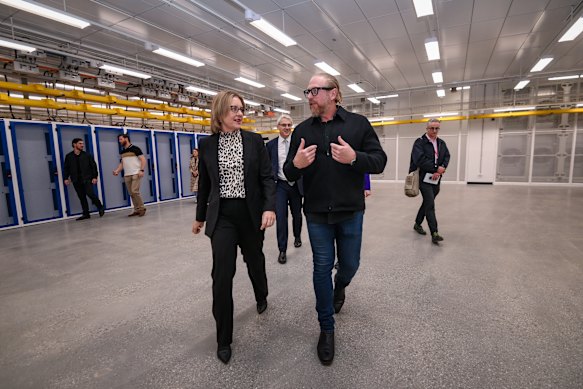
The donation arrived just three weeks after CDC attended the Australian Open, and weeks before Allan opened the company’s first Melbourne data centre facility, in Brooklyn.
Ministerial diaries show CDC executives met with Pearson or were guests at group events and meetings at least four times over the past year.
A CDC spokesperson said the company made donations “from time to time” in the form of payments to attend various business events organised by political parties, which were appropriately disclosed.
“CDC engages with government at all levels as part of our business. These engagements are consistent with how major infrastructure investors interact with government and reflect the long-term nature of our investments,” the spokesperson said.
Prior to the High Court invalidating the laws, political donations in Victoria were capped at $4970 per donor over a four-year election cycle.
Data Centres Australia chief executive Belinda Dennett, a registered lobbyist, was also an invitee to the tennis event and said it allowed the industry to discuss issues and opportunities directly with Pearson.
Dennett said the meetings she participated in focused on ensuring Victoria did not miss out on the global data centre boom and secured its fair share of investment.
She said the discussions also covered planning updates, the necessary structural inputs to support the industry, and critical resource challenges including water and energy usage.
“I think we should be proud that the government is achieving the timeframes that it said it would, that it’s attracting this investment and that it is seen really favourably by one of the most critical [industries to Australia’s future],” she said.
“It really is about having more control over how we develop and use AI in this country and attracting the jobs of the future.”
Dennett said she had met with the new Minister for Economic Growth and Jobs, Steve Dimopoulos, for a meet and greet, and hoped he continued Pearson’s championing of the industry.
In a recent submission to a NSW parliamentary inquiry, Dennett praised Victoria’s planning processes, saying dedicated teams at Invest Victoria are helping unblock stalled processes.
“The approval process is no less rigorous than NSW, but there are not long delays,” she said.
“This coupled with strong signalling from the Victorian government that it is open for data centre investment, make it an attractive market.”
Allan and Pearson have been open about their bid to attract billions of dollars in data centre investment, saying they will be ruthless in attracting jobs and want to cut red tape to attract more major players.
A Victorian government spokesperson said data centres were the backbone of the state’s digital economy, and it was going after the jobs they create.
“All proposals are assessed in accordance with the relevant planning scheme,” they said.
The state budget in May revealed data centres now serve as a key pillar of the state’s economic strategy, driving all current growth in commercial construction. Last week, The Age revealed a massive new data centre campus is also quietly being planned for Melbourne’s outer north-west.
However, such facilities are intensive users of water and electricity, triggering concerns over the grid’s ability to cope with 18 gigawatts in connection requests – with great uncertainty over which ones will actually proceed – as Victoria shifts away from gas and retires major coal power plants.
While data centres result in intensive job creation during construction phases, critics say they may create few ongoing roles once built and operational.
Start the day with a summary of the day’s most important and interesting stories, analysis and insights. Sign up for our Morning Edition newsletter.
Do you know more?
Contact The Age at da.white@nine.com.au
 Daniella White is a state political reporter for The Age. Contact her at da.white@nine.com.auConnect via X or email.