source : the age
When it comes to Diggers and Dealers, the true king of resources is not the abundance of iron ore WA produces in the Pilbara, but the shiny yellow metal that drew early prospectors to the Goldfields.
Gold is still king, and this was proven once again at this year’s conference with the number of presentations from mid-tier miners.
The price per ounce of gold rose to a staggering US$5589.38 per ounce in January this year, setting a new record, and while the value has settled again in recent months, it still sits around the US$4000 per ounce mark.
However, the labour required to get the shiny metal out of the ground emerged as a key issue at this year’s forum.
At the Welcome to Country for this year’s event, Indigenous Personnel and Training director Linden Brownley said there was a solution that offered meaningful local employment.
“Because Aboriginal people are tribal, we don’t need to leave our region to go to work – we can work from home,” Brownley told delegates.
“All we need you to do is to say yes.
“They can participate in this industry, which is the lifeblood of the Goldfields.”
Brownley added that one of the key employers in the region was Northern Star Resources – the company behind Kalgoorlie’s iconic Super Pit mine – which employs around 40 Indigenous workers.
“Because [Managing Director Stuart Tonkin] and his team said ‘yes’ to working with us, we’ve got a few members of our team who are now looking at, and some have already purchased, their own homes,” Brownley told delegates.
Will lithium continue its volatile trajectory?
PLS managing director and chief executive Dale Henderson said it best when he told the conference there was never a dull moment in the lithium sector.
“Within the year we have seen lows of US$600 per tonne and, nine months later, [highs of] US$2400 per tonne,” he said.
“Outside of that we have seen an industry evolving rampantly.
“There’s a whole bunch of new technology emerging as a function of lithium batteries – an amazing industry but, as I say, incredibly volatile.”
PLS is the operator of one of the largest hard rock lithium assets. The company’s Pilgangoora operation is set to produce more than one million tonnes of spodumene per year.
It also expects global lithium demand to increase by 240 per cent by 2040, based on recent outlook models.
While Henderson said lithium demand was broadening beyond electric vehicles and energy storage, there are still issues when it came to refining the metal.
“Although demand is growing and truly becoming global, what is not global yet is lithium refining,” he said.
“It remains concentrated – very much Asia-centric.”
Henderson added that, over the past decade, there had been a focus on resources, size and quality.
“That’s important – but more than that it is moving to what we term reliability,” he said.
“It is about the quality of the assets, it is about the economic offering, it is about the ability to deliver, and it is about the alignment with partners, community and government.”
“Lithium is an incredibly exciting industry with new growth sectors, new growth but markets, but it is incredibly volatile.
“Now to navigate that we have to move from resources to reliable supply.”
The future of WA uranium
Among his opening remarks to open this year’s event, forum chairman Jim Walker included a reminder of the strong interest in Australian uranium as a realistic option for WA.
“Uranium is again gathering serious attention as governments reconsider nuclear energy as a need for reliable base load,” he told delegates during his opening speech.
Walker’s comments follow recent calls from the WA opposition and mining industry to overturn the state’s uranium mining ban.
The Albanese government also raised hopes that the ban could be lifted after it struck a uranium export deal with India last month.
However, in his first appearance to the gold capital of WA in his newly minted role of mines minister, Daniel Pastorelli re-iterated the government’s stance on opening up the industry.
Pastorelli stuck to his guns, telling media that the government’s policy from its election in 2017 would stay in place.
Speaking at a press conference outside Parliament House on Wednesday, Australian Conservation Foundation spokeswoman Mia Pepper said history showed uranium could not be mined safely in Australia.
“Western Australia has a very prudent and popular position, which is to ban uranium mining,” she said.
“What we see with the uranium price is a reaction to speculation and announcements, and true to form, the nuclear industry has a huge variation between the reality and the promise.”
However, high prices for the commodity and the state’s ample supply of uranium likely means that questions over the government’s policy will continue.
Hockey keeps his eye on defence
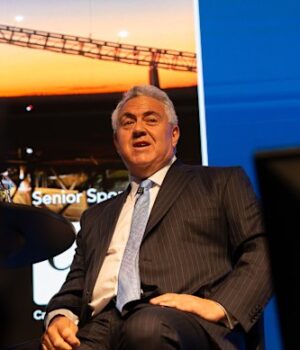
Possibly the most entertaining presentation for this year’s forum came from former federal treasurer Joe Hockey.
Addressing the forum as keynote speaker in a question and answer session on Monday, Hockey regaled delegates with a far-ranging list of topics.
From Donald Trump to Russian President Vladimir Putin, the former Australian ambassador to the US weighed in on the importance of the nation’s resources and added that the ongoing war in Iran should be of particular interest.
“A Virginia-class submarine has two tonnes of critical minerals and rare earths in it,” he said.
“The Americans only realised four years ago that a lot of that’s coming from China.
“So now America has looked at its supply chains and said, ‘Who can we trust?’ And Australia steps up, and that’s why you guys are so important.
“That’s why this industry is so important.
“It’s not just about Australia. It’s not just about 10 per cent of GDP or 60 per cent of exports.
“It’s actually crucial for the world.”
With AAP