
Source : ABC NEWS
The French Open form guide has been spectacularly torn up at Roland-Garros heading into the second week.
The pre-tournament predictions have proven to be as useful as a racquet without its strings.
Two-time defending champion Carlos Alcaraz is absent, injured.
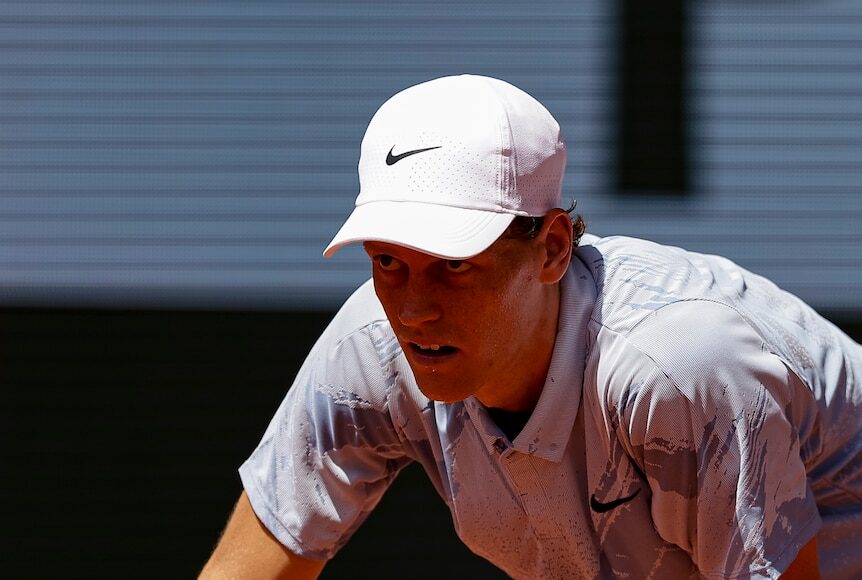
The favourites to take his title, Italian Open champion Jannik Sinner and multi-grand-slam-winning veteran Novak Djokovic, both faltered in the heat.
That means, for just the fourth time in the past 11 years, a new man will be able to add himself to the list of players to have won a grand slam singles title.
But then again, the French Open at Roland-Garros has always stood apart from the other grand slam tournaments.
This is probably fairly obvious to most viewers and fans of the sport — and not just because Roland-Garros is the only francophone major in tennis’s distinctly anglophone halls of power, although that distinction has reared its head in recent years.

The Roland-Garros complex has hosted the French Open since 1928. (Getty Images: NurPhoto/Ibrahim Ezzat)
In 2020, the Fédération Française de Tennis (FFT) made a unilateral decision to move the French Open from May to September to deal with the COVID-19 pandemic.
Despite the move being announced with zero consultation with any of tennis’s multitude of shareholders and the new dates clashing with the Laver Cup and taking place just a week after the US Open was set to finish, the FFT pushed on regardless with an implied Gallic shrug to those frustrated by the change.
C’est la vie, or something like that, I suppose.
Aside from that, Roland-Garros remains the only grand slam to retain human line judges, with even Wimbledon relenting to allow for technological aids to breach their SW19 citadel in 2025.
And yes, despite being the first major to welcome non-amateur players and heralding the open era, it has been the slowest of all the slams to raise prize money to a level that the players deem appropriate, which led to fears of a boycott to rattle around the grounds of the tournament in western Paris.
But, of course, the biggest difference is the surface. Clay.
Clay-court chaos
Jannik Sinner was knocked out of Roland-Garros in a stunning boilover. (Getty Images: Tim Clayton)
Only Roland-Garros is played on the vivid tapestry of crushed red clay, the slowest of all surfaces and uniquely unresponsive to the power game that dominates on all other surfaces.
It gives the Paris slam a unique hue completely different from the well-worn patina of the grass courts of the All England Lawn Tennis Club across the Channel and, until the 70s, at the other two grand slam tournaments.
The US Open was played on grass until 1974, while the Australian Open only shifted away from lawns in 1988.
In fact, even the fledgling Championnat de France — the early incarnation of the tournament that is now known as Roland-Garros — was played on grass, albeit only in the late 19th century before clay became the surface de rigueur in the Republique.
The US Open briefly experimented with green clay when the tournament was held at the West Side Tennis Club in Queens from 1975 to 1977, dispensing with the poorly maintained grass courts at the venue that had prompted player complaints.
When the US Open switched to its present site of Flushing Meadows in 1978, hard courts took over.
But not in Paris.
And as the grass courts of Wimbledon have slowed and the bounce has become higher and more reliable, homogenising those once-specialist lawns towards the character of hard courts, clay is the only surface where genuine specialism is enjoyed.
Think Rafael Nadal and his 14 French Open titles — he won eight combined at the other majors — and has a record of 83 matches without defeat on clay between 2005 and 2007.
Chris Evert, pictured here on the clay courts at Forest Hills, Queens at the 1975 US Open, was almost unbeatable on clay. (Getty Images: CBS)
Think Chris Evert, who lifted the Coupe Suzanne Lenglen a record seven times in the open era and once went on a 125-match winning run on clay, ending her career with an overall record on the surface of 382-22, or an unparalleled 94.55 per cent winning record by any player on any surface.
Then think of players like Jimmy Connors, Stefan Edberg, John Newcombe, Boris Becker and Martina Hingis, who won the other three slams multiple times without lifting the title in France, or other multiple grand slam champions like John McEnroe and Venus Williams who likewise couldn’t quite conquer the clay.
Of course, given that we are only just exiting the Nadal era, it might be easy to forget that dominance has never really been the French Open way.
Nadal won the Coupe des Mousquetaires so many times that he probably uses at least a couple of them as plant pots — what else would one do with 14 silver bowls?
Rafael Nadal has a lot of Roland-Garros trophies. (AP Photo: Christophe Ena)
But in the open era, it is far more common for winners to be one-and-done in Paris than at any other slam.
The men’s singles tournament at Roland-Garros has been won 15 times by players who did not win a singles title at any of the other three majors, by 10 individuals and two men who won it multiple times: Sergi Bruguera (1993 and 1994) and Gustavo Kuerten (1997, 2000 and 2001).
Additionally, Manuel Orantes won the US Open just once in 1975, when that tournament too was played on clay.
So that’s 13 men who won their only grand slam titles on clay — a shade over 26 per cent of grand slam clay titles being won by clay “specialists”.
By contrast, that has only happened four times in the men’s singles at Wimbledon in the open era, eight times at the Australian Open, and the same at the US Open (albeit one was on clay, as discussed earlier), making a total of nine on hard courts and nine on grass.
It’s similar but not quite as stark on the women’s side of the draw.
The French Open singles title has had eight one-and-done champions from a grand slam perspective in the open era, while Wimbledon has had six (Petra Kvitová won two of them), and both the Australian Open and US Open have both also had eight with one multiple winner each (Victoria Azarenka and Tracy Austin respectively).
Who could win the French Open?
Alexander Zverev may never get a better chance at winning a major. (Getty Images: James Fearn)
So who is going to be the man to step up?
Second seed Alexander Zverev may never get as good an opportunity as this to break his grand slam duck.
The 29-year-old German is often called the best player on tour without a major to his name, but the 2024 finalist reached the final in Madrid and the semifinals in Monte Carlo and Munich, so he is in good form.
He is also the highest seed remaining in the draw, with Canadian fourth seed Felix Auger-Aliassime and Italian 10th seed Flavio Cobolli the only remaining seeds in the top 10.
It’s worth saying that no unseeded man has won a grand slam singles title since Goran Ivanišević at Wimbledon in 2001, with Djokovic the lowest seed to win a grand slam in recent years when he won Wimbledon in 2008, seeded 12.
Brazilian Kuerten did win the French Open unseeded in 1997, but no player outside the top 10 in the world has won Roland-Garros since Gastón Gaudio did so ranked 44 in 2004.
Despite being ranked sixth in the world, Auger-Aliassime does not have the pedigree on clay, having never gotten past the fourth round.
What about Casper Ruud? The two-time beaten Paris finalist has had to dig deep to get to the fourth round at all, with two five-set marathons.
Next up for him? Djokovic’s conqueror João Fonseca, who will be dreaming of emulating fellow countryman Kuerten.