SOURCE :- THE AGE NEWS
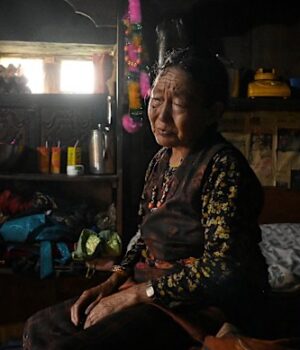
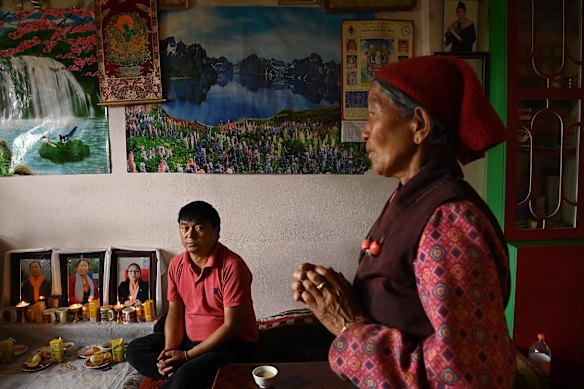
Thulo Bharkhu, Nepal: It is the first day of Buddhist mourning in the heartbroken village of Thulo Bharkhu, and a grandmother is weeping by two photos she has fixed to her dresser.
They show Santu Tamang, the only one of her six children to attend university, dressed sharply in a blazer, smiling beside his wife, Pasang. In the other frame, Yanin, 3, is sat rugged up against the cold, his little sister, Bhechen, cosied between his legs.
On paper, they are missing, but Dawa Yangji Tamang, 66, knows they are dead. Too many days have passed now. Nepalese rescuers sifting the river banks and obliterated villages along the Trishuli River are finding body parts, not survivors.
So Dawa lights candles under photos from the family’s recent holiday to the capital of Kathmandu, and cries.
“I have lost my will to live,” she says.
Thulo Bharkhu village, built onto a mountainside in Nepal’s stunning Himalayas, lost 22 sons and daughters on Wednesday last week when a glacial collapse near the border with Tibet sent an inland tidal wave tearing down the Trishuli River.
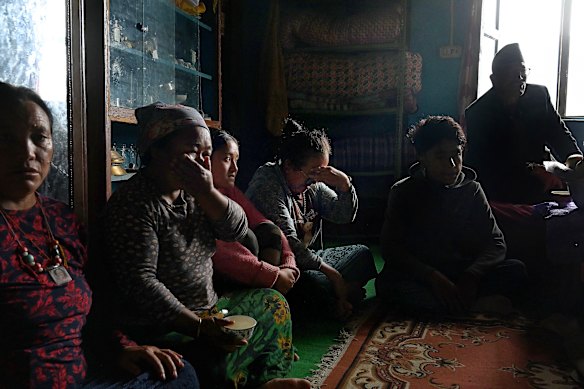
The dead had been working out of town along the river corridor, providing for their families. Those families, 12 households in total, are now performing the first of what will be a year-long series of rituals to send their loved ones peacefully to the next life. Ordinarily, the bodies would have been cremated soon after death.
Families mourn their own, then go up the street to help other families mourn theirs. No one is talking about miracles. The rituals mark an acceptance, and they are accepting together.
They serve calorific cups of a local tea made with salt, wildflower and yak butter. In Tamang culture, when people eat at funeral rituals, called Ghewa, they are also eating for the dead. The families, ever warm, insist everyone, including this masthead, eats and drinks their fill.
Dawa’s son Santu, an engineer, was the pride of the family. For a time, he had even worked in Japan.
When a job came up at the Rasuwagadhi hydro plant, one of many stations harnessing Nepal’s snow-fed rivers, he moved his family there. Santu’s relatives believe he died at work. Pasang and the children would have been taken at home.
Dawa was on a video call with the kids only the day before. They were chirping “amma”, she says – the Nepali word for grandmother
With luck, she will get their bodies. Nepal has called for international help with processing DNA and testing. For now, marked body bags are being buried in mass graves in Chitwan district. Some are going in ambulances and police buses. Anyone caught within a dozen vehicles behind will know because of the smell.
Hundreds of bodies and parts have washed all the way into India. The ones recovered in Nepal are coming out of ruins or being picked out of the muddy banks. It’s possible thousands are buried under the freshly laid quicksand.
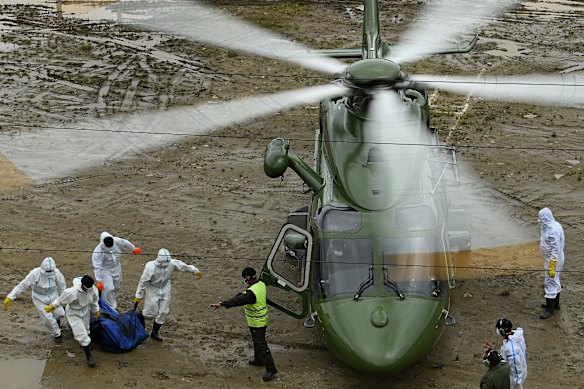
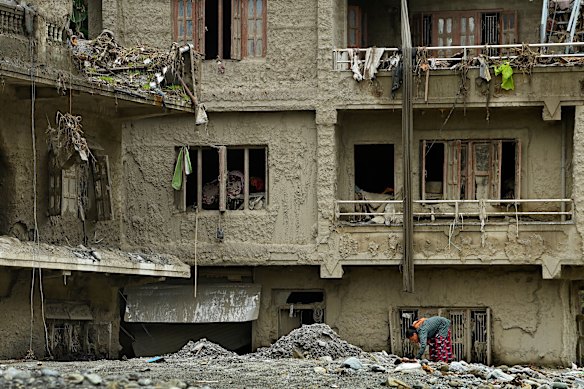
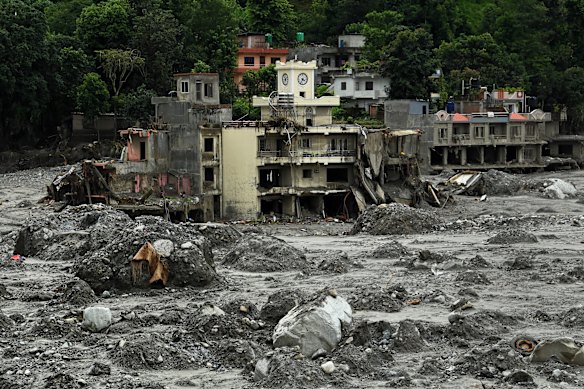
Only at river level can you appreciate the volume of water the people were up against. Steep mountainsides at the narrow passes are sheared clean of any vegetation 50 metres above the present river level.
It will grow back. Bridges will be rebuilt, eventually. But the damage to villages such as Thulo Bharkhu will last. The pain extends beyond borders and ocean, linking this small, unknown village with a profound grief being felt on many shores. At the most recent count, 36 Australians are feared dead.
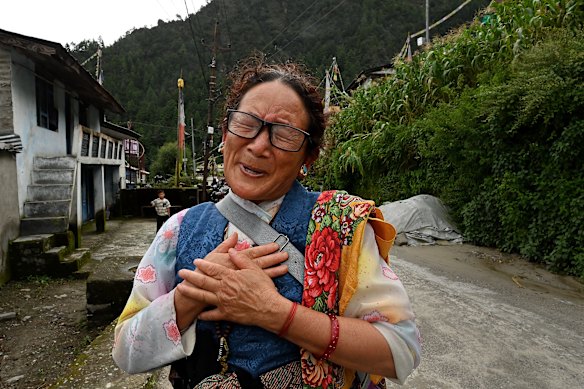
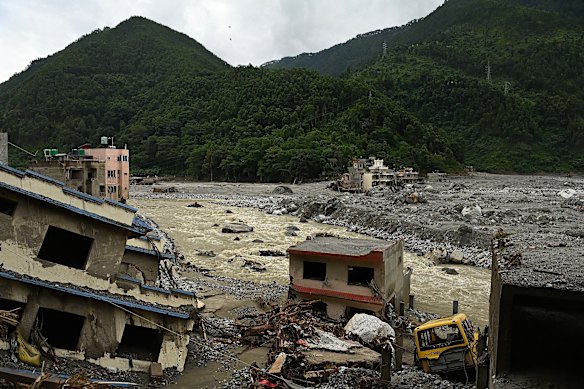
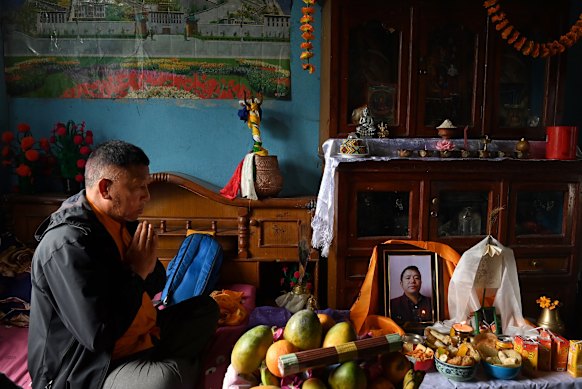
Chogyal Dorje Lama is holding a Ghewa for his wife, Pratima, his brother Thile and sister-in-law Chenku. All three were killed in Syabrubesi, about a kilometre away on the banks of the Trishuli. Chogyal’s wife, the deputy mayor, managed one final call to her husband as the river bore down.
“She was saying, ‘My mother, my mother, mother,’” he says. It is Nepalese equivalent of “my god”.
Chogyal says it sounded like she was running. “Then the voice was gone,” he says. “That voice is still coming to my head. How can I forget?”
He gazes mournfully at Pratima’s framed portrait resting low on a coffee table, recalling the community work she did for children and the elderly, how she was made to run for deputy mayor by insistent locals.
The couple were just about to try for a family. “Now, I am alone. So how to live?” Chogyal asks.
Syabrubesi is best known as the starting point of the Langtang Valley trek. It is also a stopover for Hindu pilgrims on their way north to Tibet’s sacred Mount Kailash.
Chogyal’s brother owned one of Syabrubesi’s hotels, the Royal Himalayan, and was probably inside with Chenku and guests as it was swept away at about 9am. The hotel was fully booked with 70 to 80 people the night before the flood, Chogyal believes.
At least four of the guests were Australians.
Sydney’s Sreedharan Iyer, 53, his wife, Lakshmi, 49, and the couple’s two sons, Rishab, 23, and Rudhra, 20, were travelling as part of a group of 15 Australian pilgrims, most of whom stayed the night before the tragedy at the Hotel Kailash, close to the border. That hotel was swept away, too.
The pilgrims are part of a wider group of Australians caught up in the tragedy.
Forty-three Australians were initially unaccounted for after the flash floods and mudslides struck. Seven have since made contact, but the disaster marks the biggest loss of Australian life on foreign soil since the downing of Malaysia Airlines flight MH17 in 2014 and the 2002 Bali bombings.
Sreedharan Iyer’s four brothers have flown to Nepal from India on an increasingly desperate search. They say their family members checked out of the Royal Himalayan between 8.40am and 8.50am to meet up with their friends upriver before crossing into Tibet to see Mount Kailash.

The family would have been on the road next to the river, facing the oncoming surge, if they had hit the road immediately. The brothers have faith that their cherished Australian family managed to park somewhere high before it was too late.
News articles about Australians being removed from the missing provides moments of hope, and they call this masthead asking for more details. The reticence of the Department of Foreign Affairs to publicly provide names and specific locations of the Australians being removed from the missing list is amplifying their ordeal.
Now, they are attempting to bring over a private rescue team from India. Whatever it takes.
Further north of Syabrubesi, at Timure, another family from the Sydney suburb of Cherrybrook was at Hotel Kailash.
The Muralitharan family – Chandrasekaran and Shylaja, and their sons Aarush and Ashwin – are part of the same tour as the Iyers.
At 11 and 14, the boys are among the youngest Australians affected by the floods. The family’s last communication with relatives was early in the day the floods hit. They were going to have breakfast and then head to immigration.
They haven’t been heard from since.
Both families were on a trip of a lifetime to the sacred site of Mount Kailash in Tibet, the abode of Lord Shiva – one of the three principal deities of the Hindu pantheon. The pilgrimage is arduous, the terrain and weather is testing, yet tens of thousands of pilgrims brave the conditions every year.
Meanwhile, another group of 11 Australian pilgrims were on their way back from the holy mountain, waiting at a border crossing into Nepal when the tsunami of water, ice and earth struck.
One of the travellers from that group at the border checkpoint at Gyirong, Michael Keats, from the NSW South Coast, was declared dead earlier this week. The others are still unaccounted for.
Family members of those missing at the border checkpoint are also desperately looking for information, with every passing day testing their resolve, eroding their hope.
Australia has earmarked a humanitarian support package of $11 million, and more than 40 specialist staff, including a team of specialist drone operators, are on their way to Nepal to help the search. It may not be enough for the families of the missing Australians.
Chogyal, the brother of the Royal Himalaya’s owner, is stressing about his nephew’s schooling. One is studying civil engineering in Kathmandu. The other is in high school. He sobs at the thought of finances quashing their dreams. He can provide emotional support, but not the university fees.
“They had income sources from the hotel and their mother,” he says. “Now, nothing is there.”
Aid groups are providing food and clothes in Thulo Bharkhu to fill the hole left by a missing main earner. But who’s turning up next year, or in a decade, to get the children into universities?
Bus driver Karma Waleya Tamang, 42, had been back in business for a couple of months when he died, leaving an impossible choice for his son.
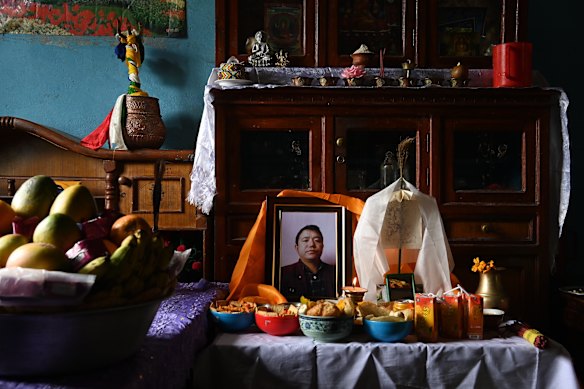
The earnings from the sale of two vehicles had been previously drained by scammers promising a nonexistent work permit for Qatar, a popular destination for low-skilled Nepalese trying to make money to send to their families
The family believes he was in the midst of ferrying passengers back from the Tibet border, when, somewhere near the destroyed town of Timure, the Trishuli devoured the bus from behind.
Until last Wednesday, Aashish, 17, had been considering studying hotel management, a career that could provide financial security and keep him in Nepal with family.
“I am the breadwinner now,” the boy says. “I will finish high school, and then I’ll go to Gulf countries for work.”
Read more on the Nepal flood disaster:
Get a note directly from our foreign correspondents on what’s making headlines around the world. Sign up for our weekly What in the World newsletter.