Source : INDIA TODAY NEWS
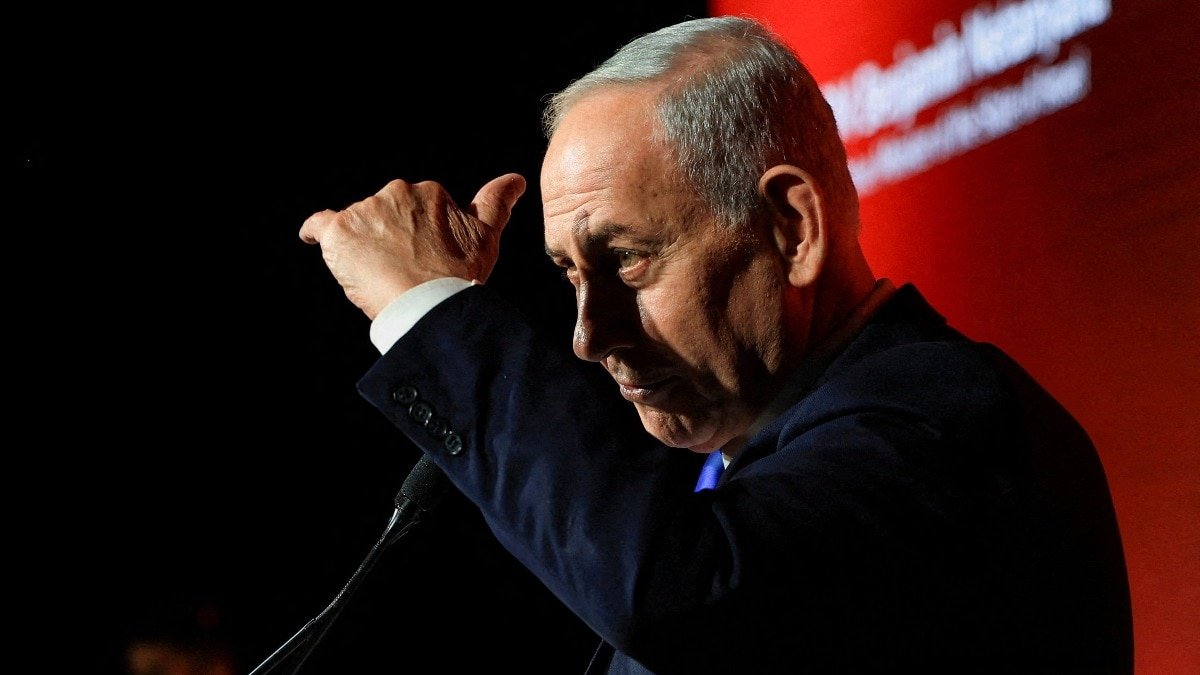
Israel’s election ended without a clear winner on Tuesday, with exit polls indicating that neither Prime Minister Benjamin Netanyahu nor challenger Gadi Eisenkot had secured a straightforward route to forming a government. The inconclusive outcome could usher in weeks of coalition negotiations or even another election, Reuters reported.
The impasse could nevertheless give Netanyahu an advantage, allowing him to continue as caretaker prime minister while political parties negotiate the formation of a new government.
advertisement
Final results may take days to emerge, and the country’s fragmented parliamentary system gives smaller parties considerable influence over who ultimately takes power. No party has ever won an outright majority of the 120 seats in the Knesset, making coalition-building central to Israeli politics.
RECORD TURNOUT PUTS NETANYAHU’S WARTIME LEADERSHIP TO THE TEST
The election attracted record voter turnout, with Israelis assessing Netanyahu’s leadership in the first national election since the Hamas-led October 7, 2023, attacks and the subsequent wars in Gaza, Lebanon and Iran.
Long queues formed outside polling stations as voters weighed the trauma of the deadliest attack in Israel’s history against the consequences of the conflicts that followed.
Netanyahu’s right-wing coalition has faced sharp domestic divisions and growing international isolation over its policies. The prime minister, however, has presented himself as the leader best equipped to confront Israel’s adversaries.
Netanyahu, 77, has held the premiership for nearly 19 years over the past three decades and has repeatedly weathered political turmoil. His opponents have displaced him only once since 2009, following four inconclusive elections over two years. He returned to office 18 months later.
OCTOBER 7 SECURITY FAILURES LOOM OVER VOTE
Netanyahu entered the contest facing longstanding corruption charges, which he denies, as well as criticism over the intelligence and security lapses that preceded the October 7 attacks. Hamas-led militants killed around 1,200 people and abducted 251 others during the assault.
For many of his opponents, the election was also a referendum on accountability for those failures. Opposition parties have pledged to establish a national inquiry, a move Netanyahu has resisted.
Despite the criticism, Netanyahu’s nationalist political base remains firmly established. Israel’s electoral system also makes it difficult for a diverse opposition to unite against his alliance of right-wing, far-right and ultra-Orthodox parties.
Urging his supporters to vote, Netanyahu warned that high participation among left-wing and Arab Israeli voters could threaten his camp.
“You all need to stream to the polls,” he said. “This is a fateful moment.”
Ruth Epstein, an 81-year-old longtime left-wing voter in Ramat Gan near Tel Aviv, described the contest as particularly consequential.
“I think these elections are the most important of all the ones I’ve known,” she said after voting for the opposition Democrats.
EISENKOT EMERGES AS STRONGEST CHALLENGER
Eisenkot, 66, a former military chief known for his hawkish security credentials, emerged as Netanyahu’s strongest challenger while presenting himself as a centrist on domestic issues. He lost a son and two nephews in the Gaza war.
Having entered politics only four years ago, Eisenkot joined Netanyahu’s war cabinet after the October 7 attacks. He resigned eight months later, criticising the prime minister’s leadership.
Netanyahu also campaigned on the backing of US President Donald Trump, his close ally during the war against Iran. Trump has urged Israel to “finish the job”.
With neither contender securing a clear path to a parliamentary majority in the exit polls, the outcome now hinges on final results and the ability of rival blocs to assemble the numbers needed to govern.
– Ends
SOURCE :- TIMES OF INDIA