Source : Perth Now news
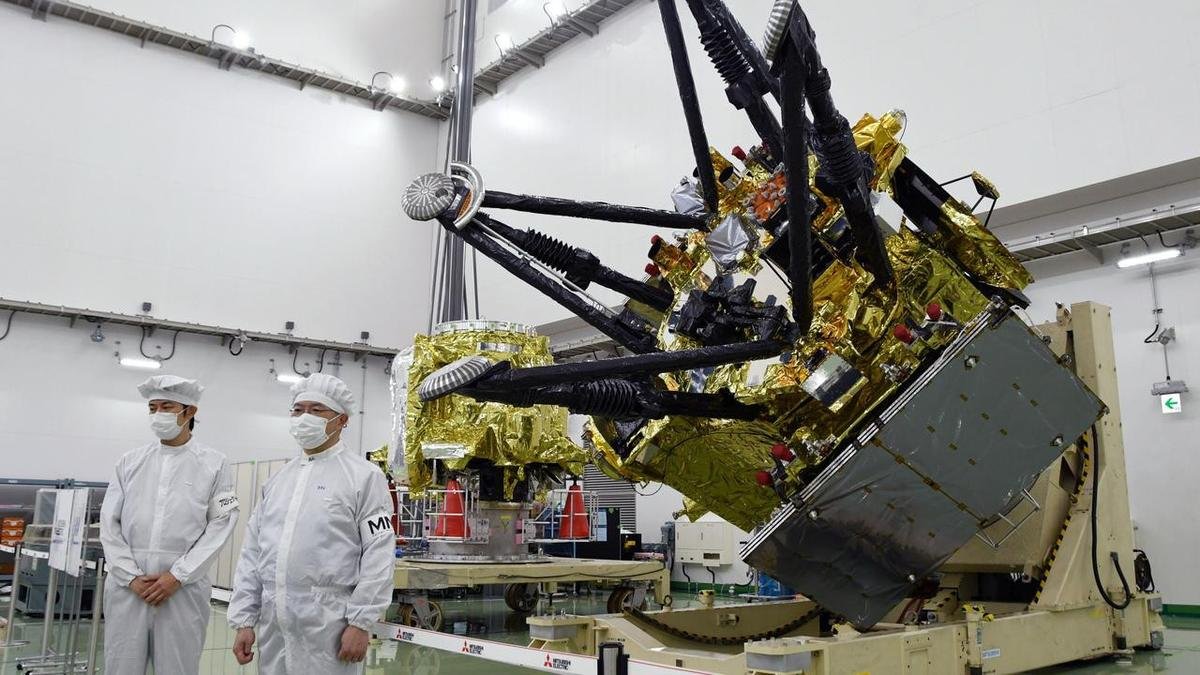
Japan is set to launch a spacecraft on the world’s first mission to bring back samples from Phobos, one of the two small, potato-shaped moons orbiting Mars.
Scientists hope the mission, which is expected to take five years, will provide clues to how Phobos and its smaller sibling Deimos formed, and hopefully shed light on the origins of life in the solar system.
The Japan Aerospace Exploration Agency’s launch of the spacecraft Tuesday on a new Japanese mainstay H3 rocket comes as the United States, China and others consider sending astronauts to Mars.
Samples from Phobos will provide useful data for scientists to consider using a Martian moon as a base for a future manned mission to the planet, said MMX project manager Yasuhiro Kawakatsu.
“Despite their potential importance, Martian moons have never been fully investigated,” Kawakatsu said. “They are known as the most important unclimbed mountains in the solar system.”
Japan leads the international mission that includes equipment and communications support from NASA and other national space agencies.
A key question will be how the moons formed and what they are made of. Some scientists think the two irregular crater-pocked bodies could be remnants of debris formed after a large celestial object crashed into Mars. Others say the moons could be asteroids that have come from elsewhere.
“We can almost certainly come to a conclusion by analysing soil samples,” MMX principal investigator Kiyoshi Kuramoto said.
Phobos, about 20 to 30 km in diameter, orbits Mars at a distance of about 6000 km three times a day.
After launching on the H3 rocket, the MMX spacecraft will arrive a year later and fly near and around Phobos for three years to collect data and gather samples from the moon before returning in 2031.
The spacecraft will carry 13 instruments, including a rover jointly developed by France and Germany that will land on the moon, as well as a NASA sampling device and instrument to measure gamma rays, and the European Space Agency’s deep space communication device.
The rover Idefix lands on Phobos first. During a 100-day mission in around 2029, it will explore the surface of the moon to help the subsequent Japanese soil-sampling.
Once the MMX lands some time later, Japanese scientists aim to collect at least 10 grams of soil.
Landing on the moon, which has just one two-thousandth of Earth’s gravity, is a challenge.
To minimise bouncing at touchdown, the MMX’s exploration module is equipped with four-legged landing gear with shock absorption features.