

source : the age
Coming off the motorway out of Slough, Archie* marvelled at the miles and miles of playing fields whizzing past on the left. “I don’t think I’d ever seen that many pitches in my life,” he said. A sports-mad, nervous 13-year-old, he took in this expanse of emerald green that was to be his making over the next five years: a whirlwind of rugby, football, “field game” and “wall game” (more on which later). As he zoomed over Windsor Bridge, his new world unfurled before him: Chapel, the red brick wall and College. Eton College, to be precise.
“I had a lot of adrenaline. My heart was going crazy. I was terrified,” says Archie, a recent Old Etonian (OE), now aged 23, of his first day at the world’s most hallowed private school.
The Berkshire campus is, after all, a rarefied bubble of educational privilege, typified by its grown-up-looking boys in tailcoats. Founded in 1440 by King Henry VI, today it hosts 1345 boarding boys aged 13-18, for a fee of £21,891 ($41,200) per term, with three terms per academic year. Around 20 per cent of the pupils are on up to 100 per cent bursaries, and “probably about 40 per cent come from families for whom the word ‘school’ means Eton,” says insider Michael* – a current Eton parent and OE who knows the school inside and out. “But the mix is far wider and more international than ever it was.”
When you’re not sixth generation (and maybe even when you are), nerves are par for the course. But first-generation Archie attests, on arrival, that he was thrown instantly into a game of football and came out muddy, tomato-red and buzzing.
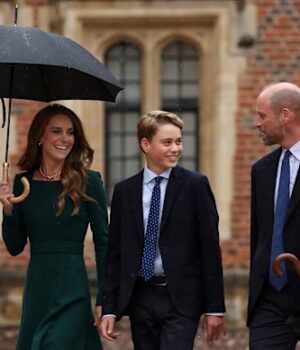
And now, school’s back. Last month, 250 apprehensive first years began their scholastic careers. Among their number are illustrious names from many nations. But one in particular is historic: Prince George, heir to the British throne. He is following in the footsteps of his father, the Prince of Wales, and no fewer than 20 UK prime ministers. Aside from political beasts (Boris Johnson, David Cameron, Harold Macmillan), there have been literary greats such as George Orwell, tech giants, Olympic stars and grand aristocratic names.
“The reason I think Prince George’s parents particularly liked Eton,” says Michael, “is that Prince William, when he was there, felt he could be very much himself. [Because of that] he made so many friends that have stayed with him. [For George, like William] there will be no special treatment: he’ll just be a normal boy.”
Indeed, being a well-connected scion or an heir – even to the throne – does not entitle you to popularity at Eton. In order to become a BNOC (big name on campus), you have to have something more than a rich or royal father. No one cares who your parents are, because almost everybody’s parents are someone. One has to earn their place at the top; and that is a question of character.
“The BNOCs were never the people with a famous parent,” says Archie. “It would be people who established themselves as such. It’s the people who see themselves as the bigger characters.” Quite often, he explains, the best sportspeople were also incredible academically, which helped their reputation.
Regardless, “Prince George will receive not just the finest education in the world, but possibly the broadest,” explains Tori Cadogan, editor of Tatler’s prestigious annual Schools Guide. “Of course, academics are excellent, with 78.2 per cent of A-levels achieving A-A* in 2025 resulting in 52 Oxbridge offers. But it’s the co-curricular, with their outstanding facilities that really sets Eton apart.
“For the famously sporty Wales family, Prince George is in the perfect place,” Cadogan continues. After all, the Prince and Princess of Wales are known sports lovers, and as a primary school student George has been said to be just as keen, participating in triathlon, football, rugby and field hockey.
“The fabulous new indoor sports centre, known as Coleman’s, has recently opened, featuring a six-court sports hall, eight squash courts, an athletic development suite, a climbing wall, and enhanced training and wellness facilities,” Cadogan adds. “This is along with the new Athens Centre, housing the incredible swimming pool and indoor basketball court.” Not to mention the 38 football and rugby pitches, 19 cricket pitches, 56 tennis courts, a nine-hole golf course and two-kilometre Olympic rowing lake at Dorney. It’s Disneyland for sportsmen.
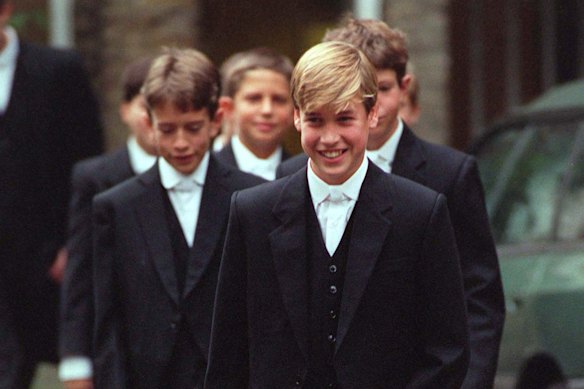
What else awaits George and his peers on campus? First years move into F Block – which is not a singular block, but refers to groups of 10 new pupils spread out in each of the 25 boarding houses across campus – a day before their seniors return. Each house has a historic name (such as Godolphin, Villiers and Walpole), rendered somewhat useless by the fact they are referred to contemporaneously by the initials of their master. One of Eton’s many idiosyncrasies.
Each house also has a dame, Eton’s version of a matron, usually the wife of the house master. She is – among many other things, I’m told – often the arbiter for the appropriateness of posters in dorm rooms. Football team or girls in tennis gear are usually OK. Nudity or vulgarity, not.
On day one, students move into their rooms (Etonians are afforded the luxury of a single room to themselves from the start), where beds have custom long and skinny mattresses, and are welcomed by a tea party thrown by their housemaster and dame.
“It’s the first time where people can eye each other up and see what the other nine are like,” says Michael. “You always get a very interesting mix of parents, some of whom know the place quite well, and some for whom it’s all new.” This has been the birthplace of many future power bromances – and surely where George will find his first tribe away from home.
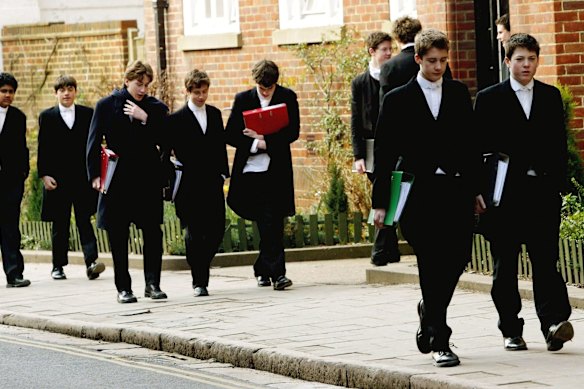
Day two begins with guided visits. Eton, like a village, sprawls over half a mile (800 metres), with lessons (“divs”) in buildings as far as 10 minutes apart. “Etonians tend to walk about 15 per cent faster than anyone else you’ll ever go on a walk with again,” says my insider. The youngsters will have to watch out, too: Judy’s Passage, which runs through the centre of the college, becomes an unruly ruckus between divs, as time is spare and the older boys “tend to throw their weight around”, says Archie. The young ones may have to duck and dive out of the way.
George will soon become familiar with things like “Burning Bush” – the Victorian street lamp in Eton town where everyone meets up. The high street is “fabulously old-fashioned”, says Archie. Very important are the two tuck shops, Rowlands and Tudor Stores. “Rowlands sells chips, ice-creams, sweets and sandwiches. And Tudor Stores, on the edge of the high street, is considered to have the best ice-cream in the school,” says Michael.
The F-blockers will already be familiar with any one of its tailors (Tom Brown, Welsh & Jefferies, New & Lingwood, Billings & Edmonds), where they will have recently been measured for two sets of tails, waistcoats and trousers. “It’s very untouched, very old-school, but it’s not a Savile Row experience,” says Archie. “It’s like you walking into a dry cleaners, but every single thing on the shelf is tailcoats, because all the tailors also handle the cleaning. There’s no cigar lounge in the corner.”
That evening, they will learn how to apply the stiff collars with studs, as taught by the dame. “It normally takes about three attempts to learn how to do it, then after that it becomes second nature, and you can do it in three seconds flat,” says Michael.
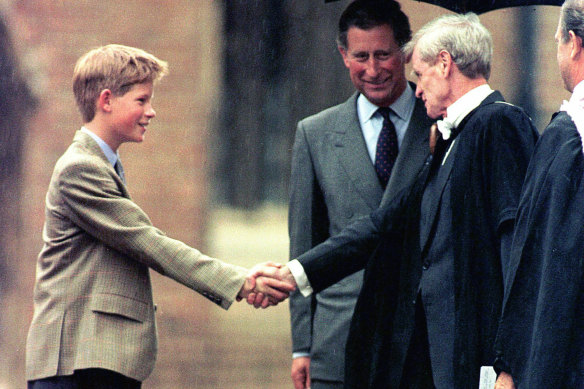
By the third day, George and his contemporaries head to College, the oldest part of the school, where the Provost, Nicholas Coleridge (descendant of Samuel Taylor), ultra charming and ultra connected after decades in leadership at Condé Nast, gives a speech. I’m told last year he advised “finding two or three things that you particularly enjoy doing and doing them”. And goodness do they have choice: sports, theatre, painting, drawing, debating, student journalism, theology …
There are some early trials, too – including a mandatory singing test for Eton’s three world-class choirs. “Some boys are very keen to get in and some are very un-keen to be chosen, so they sing badly on purpose,” chuckles Michael. And in classes, which start around day three for the youngsters, the masters (or “beaks”) treat pupils in a very adult way: “You feel like they’re talking to an equal even though they have, like, three PhDs,” says Archie. It is perhaps one of the reasons the OEs leave with such applicable confidence.
Soon, the rhythm of the day will kick in. An alarm bell rings throughout the house every five minutes from 7.15am to 7.30am, by which time everyone must be at breakfast, which, on a normal day, is cereal, toast, eggs, beans and bacon, and on Sundays is a full-English-style fry-up. Breakfast is followed by Lower Chapel for the first two years, then they move into the famous big Eton Chapel. It’s a 10-minute morning service, with one hymn and a prayer: “Usually 19 out of 20 boys are sitting alert and to some extent listening, then the 20th has his head resting on a hymn book, and clearly half-asleep,” says the insider. But all agree, even for the non-religious, it is the tradition most missed on departure.
Five 40-minute-long divs in the morning are split by Chambers (elevenses – “A morning snack of cheese on toast or a sausage roll,” says Archie. “Occasionally, we’d get a slice of square pizza”) and followed in the first two terms by two hours of intense sport. First years in their first term must choose either rugby or football, but as they get older, more choice opens up. There are two more divs before EW (extra work) and then dinner; for some, in house, and for others, in a communal canteen. “Everyone would pile in and suddenly the noise was a million decibels,” says Archie. ”Then it falls dead silent and the housemaster gives grace.”
A hearty meal has been well-earned by this point, which is why, according to one OE, scandal arose one Friday when a new chef decided to do “healthy” fish ‘n’ chips. “There was outrage,” says the OE. “We’re used to having a big battered cod, big chunky chips, mushy peas, just slopping on a plate. And then you come in and it’s this little pale, white, uncouth boiled cod and new potatoes … We started a food committee after that.”
George might also find himself pulling into the illicit world of snack trading. As one insider told me: “A healthy supply of tuck equalled trading power. One student had a fake can of Heinz baked beans that the bottom came out of, and kept the keys in there for his tuck box. He’d exchange a bar of chocolate to make his bed; four slices of toast to take his tails to the cleaning rack.”
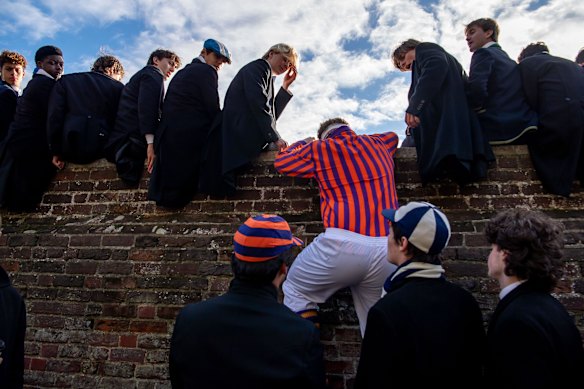
And of course, Eton would not be Eton without its unique sports – wall game and field game, early iterations of rugby and football. “Some people think it’s a very good game, but it must be said it never caught on at any other schools,” says the Eton insider. Nevertheless, for those in a sporty house, winning the annual Ties championship in either sport is the pinnacle of success. For others, it will be top grades and others again learning the ability to debate like a great.
“It is a very great privilege to attend such a physically beautiful school,” concludes Michael. “It’s got something slightly more sophisticated in the air, and that often rubs off on a number of the boys.” And, indeed, not one but now two future kings.
* Names have been changed.
This is an edited extract from The Telegraph, UK
Get the best of Good Weekend delivered to your inbox every Saturday morning. Sign up for our newsletter.
Read more from Good Weekend:


