source : the age
To submit a letter to The Age, email letters@theage.com.au. Please include your home address and telephone number. No attachments, please include your letter in the body of the email. See here for our rules and tips on getting your letter published.
Motorcycles are increasingly hazardous on today’s public roads, not because riders are reckless, but because the infrastructure itself is failing them (″Crash victims part of a growing wave of litigation″, 23/9). Potholes, crumbling surfaces and poorly maintained lanes create traps that cars can absorb but bikes cannot. A minor defect at speed can mean a catastrophic crash.
Riders face an outsized exposure to danger. With no seatbelt, airbag or crumple zone, they meet the road directly. Injuries are severe and rising, turning what should be routine commutes into high-stakes gambles.
If motorcycles were invented today, would regulators permit them on public roads? Given modern safety standards, noise limits and emissions rules, it is doubtful. Yet, we tolerate their risks as inevitable rather than addressable. It is time to ask whether our roads are designed for people, or merely for vehicles.
Angus McLeod, Cremorne
Examination of construction needed
The crash victims story highlights the condition of our roads. This reminds me of the number of bird-bath pools of water visible on roads after rain, which instead of draining off the surface seeps through the tar, softening the road foundations leading to potholes. This suggests more attention should be given to the construction of roads including camber, foundations and paving of road surfaces.
Kim Dunstan, Brighton
Spend more on maintenance
It is not as if road engineers have forgotten how to build and repair roads. What has changed is the increase in commerce caused by more people and the increase in traffic that is a result.
The problem is worsened by the increase in weight of vehicles. Trucks have been replaced by B-doubles and sedans have been replaced by SUVs, big utes and electric cars and their weighty batteries. We need to spend a lot more on road maintenance, but that can be funded only by higher taxes and road-usage charges.
Welcome to the future.
Peter Hendrickson, East Melbourne
Dodging and weaving in the commute
Re ″Drunk driver weaving all over the road, or pothole dodger?” (Letters, 19/9): On the busy morning commute along Neerim Road between Murrumbeena Road and Kambrook Road, continual pothole dodging and weaving is the norm for drivers, cyclists and motorcyclists. It’s an increasingly hazardous, potholed journey as cars, buses and bicycles dodge and weave around the ever-more numerous, ever-larger, ever-deeper potholes.
On occasion, traffic in both directions must simultaneously zig-zag, while cyclists in bike lanes – mostly children on their way to school – also dodge and weave. With this crowded, pothole-dodging, moving mass of mixed commuters, it’s only a matter of time …
Deborah Morrison, Malvern East
There is a mental health toll
It is traumatic to drive any Victorian road, dodging potholes with anxiety compounded by being on high alert for previous pothole locations, even after they have been filled. What is the mental health impact of lax road and drainage maintenance?
Cherie Forrester, Gembrook
Everything is connected
It is easy for people to dismiss the focus on potholes as “insignificant given the challenges of climate change and war-induced economic disaster”. In fact, this issue highlights the factors that underpin the social unrest and political disconnection affecting our communities. These include the harmful effects of privatisation and of elites profiteering at the expense of essential services. Add the failures of the political class to act on the everyday impacts of climate change and we are linked back to potholes. Economics, environment, politics – everything is connected.
As we mourn the loss of activist Gloria Steinem, I’m reminded of her quote: “The future depends entirely on what each of us does every day; a movement is only people moving.”
Philomena Horsley, Carlisle River
THE FORUM
More than lip service
The Liberals’ updated energy policy includes a core commitment to set up a “technology-neutral” capacity planning mechanism, including nuclear, coal and gas. Priorities will be affordability and reliability.
In addition, you would hope that they would include as a priority the contribution to carbon emissions.
If the Liberal-National parties want to pay more than lip-service to climate action, they must keep carbon emissions reduction as a core part of their energy policy.
John Hughes, Mentone
PM, here’s the mail
Prime Minister Anthony Albanese needs to take off the blinkers, sack his advisers, stop listening to vested interests, read the letters to The Age, and follow the advice given. There’s still time to stop the downward spiral Australia is in because of his timid approach.
Albanese must use his majority and redeem himself and his government.
Belinda Burke, Hawthorn
The trust dilemma
What matters more for Australia (Comment, 23/9) than public knowledge of government workings is public trust. Unfortunately, increase in public knowledge can result in decrease of public trust, which is why governments fight tooth and nail against more transparency.
Ruth Farr, Blackburn South
Shameful echo
“Aborigines are the most primitive people on earth.” The last time I heard that was in grade 4. It’s taken most of my 82 years to learn how wrong, demeaning and ignorant white attitudes were. It was a shock to hear Pauline Hanson say it.
I apologise to Indigenous people for quoting the words.
Anne McNamara, Armadale
Irony bypass
Donald Trump criticises Australia for its stance on AI, arguing that it would be an assault on free speech the day after the Washington press pool downs tools in retaliation for Trump banning three networks from press conferences because he doesn’t like their coverage.
Stephen Dinham, Metung
Plan out of touch
I read Julian Leeser’s Liberal plan for solving the difficulties faced within schools, and was saddened and disappointed.
As a humanities teacher of 42 years across a range of schools in inner-city and regional settings, I wonder about his understanding of such things as “pride in the Australian flag and Western culture”.
Amazed at the idea of “removal of Indigenous history and culture, Asia and Australia’s engagement with the region and sustainability” because they’re not being taught by people with expertise in those fields. This just sounds like a policy that is so out of touch with the reality of teaching in 2026.
To teach Indigenous history in “discrete, carefully planned topics” reminds me of how we were taught about Indigenous history back in the 1960s.
What does he mean by “our British foundation and multicultural character”, yet not teaching about our Asian region!
The most disturbing aspect of the plan is the encouragement of ex-ADF staff to become teachers after one year because they “have no problem with discipline”.
Kathy Diviny, Coburg
Asleep at the wheel
One wonders how much consultation took place with residents before the construction of these monolith-type buildings housing the AI data centres, or did the authorities say aren’t they lucky to have a data centre located on their doorstep?
All very well for the government to now introduce planning regulations but in a number of cases the gate has been well and truly shut after the horse has bolted. These controls should have been part of the approval process, so one can only surmise the government was asleep at the wheel when applications were considered. Why is it not possible for architects to design buildings that are neighbourhood friendly so that in 10 or 20 years, we can be proud of the structure instead of buildings that make grain silos look positively attractive?
Bruce MacKenzie, South Kingsville
AI safeguards
The prime minister is to be commended for seeking greater safeguards on AI development (“PM joins global push for new AI safeguards”, 21/9). Given the threat of AI-developed biological weapons, the government is also to be commended for its efforts to strengthen the Biological Weapons Convention with a board of experts and enhanced verification and compliance measures. However, it could do more to reduce the risks of AI-related harms.
It should significantly increase resourcing to the Australian AI Safety Institute. It should also require mandatory reporting of significant AI-related harms by developers and sellers of AI models, and voluntary reporting for users negatively affected by AI. The government cannot regulate a problem it doesn’t fully understand.
Having a reporting mechanism for significant harms would create an evidence base to inform regulators, provide early warnings of systemic risk, and build public trust in the legitimate use of AI.
Mark Zirnsak, Parkville
Children the losers
The Royal Children’s Hospital is begging for funds to staff its new emergency department. The government’s response – “the government was working closely with the hospital to transition services into the expanded emergency department″.
No new staff, just robbing Peter to pay Paul.
Peter Randles, Pascoe Vale South
Not the news
Donald Trump’s love for TV, enthusiasm for allowing reporter access, and frequent press conferences are of little democratic value where much of what he says is exaggerated, stripped of context, or simply untrue. The term ″transparent″ implies that Trump’s White House provides the public with access to accurate information about government activities, decisions, and budgets. It doesn’t. Rather, it gluts the media cycle with self-serving distortions. Sheer quantity over quality.
Declan Melia, East Melbourne
Justified objections
Carlton residents who object to large crowds drinking on public land near their homes are justified in their objections (″No happy median in clamp on roadway drinking″, 22/9). Many well-known problems arise due to the combination of crowds and alcohol. There are many existing options for alcohol consumption, and making this space an alcohol-free one isn’t making it ″sacrosanct″ at all – it’s simply reinforcing the rights of everyone to enjoy the area safely and without nuisance. Not being permitted to drink there is a reasonable sacrifice to make for community harmony. Abstaining in relaxed outdoor environments seems to be challenging for many, but it is possible.
Bruce Watson, Belgrave
Wrong priorities
The plan by Opposition Leader Jess Wilson (″Coalition pledges new select-entry high schools″, 20/9) to spend millions building more select-entry schools to further advantage students who are already capable will further destroy the public education system and decrease overall educational outcomes in Victoria as public schools lose their role models and mentors. This money could be better used to build state-of-the-art technical schools in the outer suburbs mentioned in the article to provide the builders and tradies we need.
Lauren Basil, Footscray
Iran’s long game
For a theological dictatorship, the Islamic Republic of Iran sure knows how American democracy works under Donald Trump. In the words of Paul Keating, they are ″doing (Trump) slowly″ by extending the war for as long as it makes Trump look bad leading up to the mid-term elections in November. Trump’s war-mongering and talk of annihilating Iran is like water off a duck’s back for the Iran leadership. They know US voters will do more damage to Trump than a barrage of drone attacks.
Nick Toovey, Beaumaris
Peace remains elusive
Columnist Rodger Shanahan (Comment, 23/9) states that while Israel’s simultaneous occupation of Syrian, Palestinian and Lebanese territory may give Israel short-term security, wise leaders understand that long-term security comes through a willingness to cede land for peace.
But the reality is that previous Israeli offers and actions to cede land in surrounding territories resulted in the Second Intifada, Hezbollah’s reoccupation of southern Lebanon, and October 7, 2023. Long-term peace has been maintained between Israel and neighbouring Jordan and Egypt, including in the latter case by Israel’s ceding of the Sinai Peninsula.
However, a lasting peace remains elusive with a Palestinian leadership which either seeks Israel’s elimination, in the case of Hamas, or else has a “pay for slay” policy of rewarding terrorism, in the case of the Palestinian Authority.
Geoff Feren, St Kilda East
Putin on the blitz
Vladimir Putin no doubt had pre-election jitters, concerned that the Ukraine war might have had an impact on his electoral appeal (“Putin secures Russian vote”, 23/9) – a war that has resulted in possibly 500,000 Russian fatalities, caused fuel shortages and pushed up food prices.
He must feel relieved and chuffed that his party, despite all of this, was still able to achieve a record number of seats in the Russian parliament.
Dennis Walker, North Melbourne
Waning power
Despite his bluff and bluster, the self-proclaimed ″genius″ US President Donald Trump is steadily eroding his power, influence and relevance on the world stage.
Jon Smith, Leongatha
AND ANOTHER THING
Trump
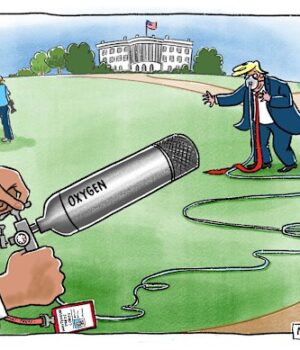
President Donald Trump is right – he runs the most transparent White House ever. Everybody, except the willfully “blind”, can see right through him.
Bernd Rieve, Brighton
Another Trump deal to end the “military conflict” after the midterm elections. Why am I
not convinced?
Graham Fetherstonhaugh, North Fitzroy
For Trump, who claims to be master of the deal, a media boycott was always on the cards. Long live the free press.
Jenifer Nicholls, Windsor
I know it’s not a peace prize but will Donald Trump get a participation ribbon for turning up at the UN’s General Assembly and giving a rant?
James Lane, Hampton East
Furthermore
Pauline Hanson needs a more down-to-earth means of transport. Can someone give her a bicycle? (“Questions over One Nation’s missing plane”, 23/9)
Jenny Smithers, Ashburton
Brisbane Lions player Lachie Neale’s story is truly painful. As a St Kilda supporter, it resonates deeply with the absence, through suspension, of Carl Ditterich from our only premiership team,
60 years ago in 1966. Time has not healed that anguish.
Mark Cherny, Caulfield North
Data centres are not a panacea for economic ills.
Helena Kilingerova, Vermont
With regard to the potential for artificial intelligence to escape, did no one learn anything when HAL refused to open the pod bay doors in 2001, A Space Odyssey?
Greg Brown, Tarneit
Your correspondent (Letters, 23/9) is correct to write, “if climate change is an intergenerational threat, 37 new fossil-fuel approvals is an odd response”. He could also have written not if, but when.
Lesley Walker, Northcote
Finally
Smart glasses can be easily hackable? We’ve all been framed!
Ian Macdonald, Traralgon