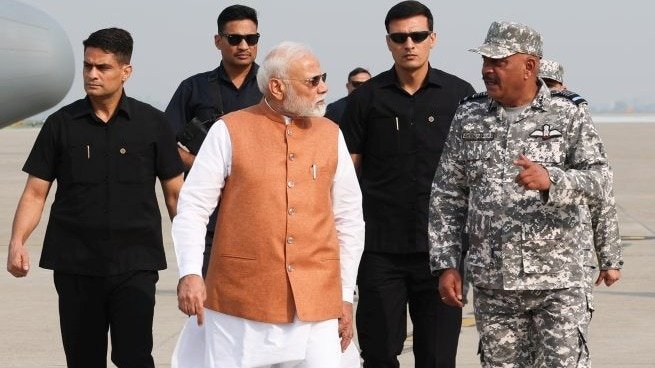
Source : INDIA TODAY NEWS
The S-400 air defence system was the star of Operation Sindoor, playing a major role in countering Pakistan’s aerial threats. Now, Air Marshal Jeetendra Mishra (retd) has revealed that Pakistan was so desperate to locate these S-400 systems that it activated spies and sleeper cells inside India during the May 2025 hostilities. In an interview with ANI, Mishra, the chief of the Western Air Command during Sindoor, said that due to the S-400s, Pakistan’s fighter jets could not come within 200 km of the Indian border.
advertisement
The revelations on Operation Sindoor by Mishra, who was awarded the Sarvottam Yudh Seva Medal, are the most extensive to date. According to the Air Marshal, the Russian-made S-400 system emerged as the biggest threat to Pakistan’s air operations during the conflict. It forced Pakistan to employ all the tricks in the book, Mishra said.
‘S-400 BECAME PAKISTAN’S BIGGEST THREAT’
“Pakistanis were desperate to find where these S-400s were. They used every available means. They were also getting satellite help from other nations,” the Air Marshal said. Even though Mishra stopped short of naming the nations, an Army official previously confirmed that China was providing real-time intel inputs to its ‘all-weather friend’ Pakistan.
“Every time they (Pakistan) got airborne, they were shot by an S-400. The S-400 was the biggest threat as far as they were concerned. They also activated spies and sleeper cells within India to find out where the S-400s were located,” the Air Marshal revealed.
The S-400, dubbed India’s Sudarshan Chakra, is a surface-to-air missile system that is a crucial cog in the country’s air defence. With advanced radar and interception capabilities, the S-400 can spot and shoot down aerial threats from far away.
In 2018, India and Russia signed an agreement for five S-400 systems. Three have already been delivered and inducted into the IAF. A fourth squadron was received in June this year.
‘MILITARY FACED NOT A SINGLE RESTRICTION’
India launched Operation Sindoor as a retaliation to the Pahalgam terror attack, which left 25 tourists dead. The Air Marshal said that while the military was given “operational freedom”, the direction from the government was to avoid civilian casualties.
“The direction was there should be no collateral. We don’t want common citizens to be affected. Only terrorists and their handlers are to be punished. We are not a war-mongering state,” Jeetendra Mishra said.
In the same vein, he added, “There was not a single restriction. It was left to the military to decide how to fight the war.” The remark is crucial, as the opposition has repeatedly alleged that the government tied the hands of the armed forces.
Mishra said matters could have ended after India struck nine terror camps, including those of Jaish and Lashkar, on May 7, but Pakistan chose to escalate.
Pakistan initially launched 14-15 drones targeting the Adampur air station. However, all of them were neutralised. On May 9, however, Pakistan launched hundreds of drones and missiles.
Mishra revealed that one long-range, GPS-guided drone hit a hospital at the air force station and a civilian office located next to it. “I lost one airman, and one person lost his arm. He was amputated. They were medical assistants,” he said.
Pakistani forces also attempted to target civilian areas and places of worship, including gurdwaras. It was then decided that India would not take it lying down and would retaliate.
HOW PAKISTAN GOT BLINDED AND PARALYSED?
Mishra said the IAF first dismantled Pakistan’s ability to detect and coordinate its air operations by targeting ground-based radars and command-and-control centres.
“We destroyed all their radars, including American AN/TPS series ones in Punjab. We also got two of their command and control centres. So, they were blinded,” he said.
With ground-based radars destroyed, the Pakistani forces became increasingly dependent on airborne platforms, or AWACS. An AWACS aircraft was deployed from Sargodha, but it was shot down by an S-400.
“The only way they could see was through an airborne radar. My S-400 operator asked me if he could shoot. I said shoot. And when he shot, we got it at 314 km,” Mishra said. It marked the longest surface-to-air kill in military history.
The Air Marshal said it basically altered the balance of the conflict. “India could hit anywhere in Pakistan, and Pakistan could do nothing about it,” Mishra said.
The day of reckoning for Pakistan came on May 10 as India struck 11 military stations, including vital bases like Nur Khan and Bholari. Hours later, Pakistan scurried for a ceasefire, ending three days of intense hostilities.
The former Western Command chief also revealed that women fighter pilots played a significant role in the operation, flying multiple combat missions.
“Women pilots did more than one mission. They struck LeT’s Muridke headquarters, and the same pilots went back and hit airbases and the command and control centres on May 10,” Mishra revealed.
– Ends
SOURCE :- TIMES OF INDIA