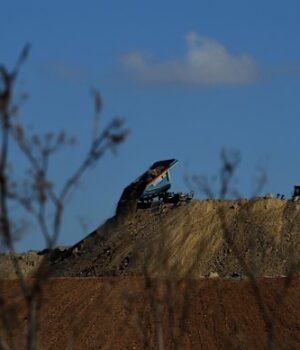
Source : the age
Approval for a major coal mine expansion has been declared invalid by the High Court in a decision that will force NSW planning authorities to reckon with emissions from Australian coal burnt overseas.
Legal and industry experts warn the ruling will ripple across the sector, potentially exposing recent coal mine approvals to judicial review and opening a “Pandora’s box” of questions about how Australia accounts for the climate impact of its fossil fuel exports.
The open cut mine also falls within the key political battleground of the Hunter Valley, which has been fought over by Labor, the Coalition and One Nation.
Environment Minister Murray Watt said the government was still considering the 111-page judgment handed down on Wednesday, while casting doubt on the idea of a new national precedent.
But the federal opposition is demanding that the Albanese government intervene should the NSW Labor government fail to urgently pass new laws, a call also seized upon by One Nation.
“We’ll become poorer, and poorer nations cannot pay for the public infrastructure and the social security benefits that are part of the birthright of this nation,” One Nation deputy leader Barnaby Joyce said.
NSW Natural Resources Minister Courtney Houssos noted the Mount Pleasant project has a separate approval to continue operating until 2032.
Backing what she called “the existing framework” for approvals, Houssos said the High Court decision “does not mean the expansion cannot be reconsidered or that coal mine extensions cannot be approved.”
As one of the world’s largest exporters of coal, gas and iron ore, Australia’s so-called scope three emissions – the greenhouse gases released when customers across the world burn or process those products – dwarf the domestic emissions from mining and drilling.
Environmentalists hailed Wednesday’s ruling. “When Australian coal is burnt overseas, the climate damage doesn’t magically disappear at the port,” the Greens’ new deputy federal leader Steph Hodgins-May said.
Anita O’Hart, a lawyer for the environmental group fighting the project, called the victory “a groundbreaking decision for climate law in Australia” that would be studied closely by other countries.
The mine’s owner, MACH Energy Australia, won approval in 2022 to significantly expand the mine and extend its life by 22 years. It outlined measures to address domestic greenhouse gas emissions from the project.
But it also concluded that 98 per cent of the total emissions would be classed as scope three.
The owner argued these emissions would be managed “in accordance with customer countries’ commitments under the Paris Agreement” and would not “contribute to Australian greenhouse gas emissions”.
Neither the NSW Department of Planning and Environment nor the ultimate decision maker, the Independent Planning Commission, took issue with the company’s position.
The mine owner survived one legal challenge from environmentalists known as Denman Aberdeen Muswellbrook Scone Healthy Environment Group Inc, before the tables then turned in the NSW Court of Appeal.
The High Court on Wednesday upheld the lower court’s decision, but on a different basis.
Under NSW law, the Independent Planning Commission needed to consider imposing conditions on an approval to ensure “that greenhouse gas emissions are minimised to the greatest extent practicable”.
Justice James Edelman said: “Members of the Commission did not address that requirement with respect to scope 3 emissions, amounting to 98 per cent of the project’s emissions, because they considered that those emissions would be accounted for in the countries to which the coal was exported.”
Edelman continued that “by focusing only upon two per cent of the project’s emissions”, the commission had failed in its duty to fully consider minimisation conditions.
Justice Michelle Gordon said it was not the High Court’s role to weigh in on the merits of this requirement or to say what conditions might be imposed to minimise emissions. But Gordon found the failure to at least consider conditions was a “material” error that invalidated the expansion approval. Justice Robert Beech-Jones agreed.
Two other judges, Chief Justice Stephen Gageler and Justice Jayne Jagot, disagreed with the majority in finding that the planning commission had adequately considered emissions overseas.
They quoted the commission’s finding that “with the adoption of the Paris Agreement, almost all countries have committed to reduce global [greenhouse gas] emissions and to track their progress in doing so”.
Watt said the government’s early assessment was that the impact of the High Court decision would be limited to NSW.
“It doesn’t automatically transfer to Commonwealth decisions or Commonwealth legislation,” he told News24 shortly after the decision was handed down.
Watt reiterated that scope three emissions did not need to be considered under federal law, but said other states may be impacted depending on their legislative settings.
In a joint statement released on Wednesday afternoon, Opposition Leader Angus Taylor and Nationals leader Matt Canavan described the decision as “absurd”, seeking to blame Labor for the ruling.
“The decision turns on the wording of NSW planning law. That means it can be fixed, and fixed quickly. The Coalition calls on the Minns government to act immediately to introduce legislation amending the Environmental Planning and Assessment Act.
“It must make clear that overseas emissions from Australia’s exported resources are not a consideration in project approvals,” the Coalition leaders said.
“If the NSW state government won’t act, the Albanese Labor government should legislate to fix this issue and provide certainty to workers, business and our international energy partners.”
Previously, Australian courts have accepted that the responsibility for emissions caused by the end use of fossil fuels lies only with the emitter, according to Grattan Institute senior fellow Tony Wood.
The Mount Pleasant decision now opened a “Pandora’s box of messy questions” for proponents of new emissions-intensive resource projects and planning authorities, especially in NSW, Wood said.
Peter Briggs, head of the environment, planning and communities team at law firm Herbert Smith Freehills Kramer, said “it will definitely have impacts on NSW coal projects” as planning authorities could no longer “pay lip service” to climate change mitigation.
Mallesons partner James Wang said the decision, even if it was confined to the construction of a NSW law, may “encourage activists to bring more challenges to environmental approvals”, triggering a wave of litigation.
Mining industry sources warned the decision could expose NSW mine approvals granted in the past six months to judicial review. Outside NSW, they said, companies expected the ruling to prompt heightened scrutiny of approval documentation for major coal and gas projects with heavy downstream emissions, rather than posing an immediate threat to existing operations.
Minerals Council of Australia chief executive Tania Constable said the decision sent a “very negative signal” to trade and investment partners regarding sovereign risk.
“Developing a coal mine in Australia is already difficult enough because of long approval times, lawfare by activists and high royalties and other taxes,” Constable said in a statement.
But former Greens leader Adam Bandt, now the head of the Australian Conservation Foundation, said the High Court ruling was “a recognition of the science, something that the governments and corporations have fought for a while.”
Cut through the noise of federal politics with news, views and expert analysis. Subscribers can sign up to our weekly Inside Politics newsletter.
 Nick Toscano is a business reporter for The Age and Sydney Morning Herald.Connect via X or email.
 Nick Newling is a federal politics reporter for The Sydney Morning Herald and The Age.Connect via X or email.