Source : PERTHNOW NEWS
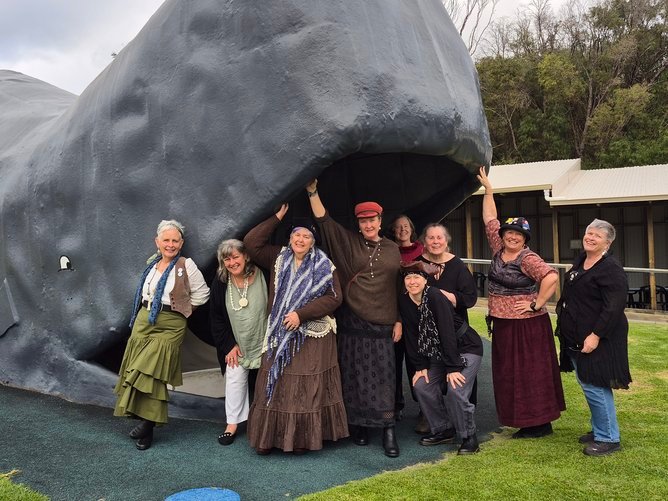
Move aside, scurvy dogs, the She Shants are hoisting their colours high as they sail the seas of maritime folk entertainment.
Formed 10 years ago as an “impromptu” response to male shanty singing, this nine-piece all-female crew has been building a repertoire and fan base in a genre that is predominantly blokey.
Tapping the rich era of sail — when sea shanties helped sailors perform the hard physical labour of hoisting and rope work — the Perth women expand on traditional themes of homesickness, lost love, drinking, storms, wrecks and humour, while etching a distinct female perspective.
Original member Monica Lacey says the group’s origins grew out of the fact that several members had partners in the popular male sea-shanty group, The Lost Quays, based in Fremantle.
“There was an opportunity, simply as a bit of fun, to sing a song at a shanty-off — a shanty battle that was occurring at Fairbridge Festival between the Lost Quays and the Albany Shantymen,” Lacey recalls.
“We put together a song and hopped up to perform it, really as a female response. A lot of traditional shanties are quite awfully misogynistic, so we thought we might as well have a response ready for that.”
That song, ‘Twiddles’, flipped the idea of sailors having a “girl in every port” to women on shore having “a man on every ship”. That reversal of gender assumptions set a course for the group’s future.
The She Shants became regulars at the monthly Shanty Club at Clancy’s in Fremantle, continuing to develop their song list. They soon had enough material to perform at festivals, giving women an active voice in stories in which they had traditionally been passive: wives, sweethearts, sex workers, working women, not to mention mythical creatures.
In reimagining a song called ‘The Mermaid’ into ‘The Mermate’, the She Shants created a crowd favourite. The original tells of a sailor who falls in love with a mermaid but is dissatisfied because her upper half is a woman and her lower half is a fish. After she leaves him, he encounters her sister, whose upper half is a fish and lower half is a woman. The re-created Mermate includes: “His toes are pink and rosy / And his knees are smooth and pale / I don’t give a damn about the upper parts / And that’s how I end my tale.”
And in Lacey’s sea-creature tune ‘The Kraken’, a lusty lovelorn female sea monster wrecks ships and drags sailors to the depths before meeting a monster her own size.
Repertoire development and arrangement is a collective process, without a designated leader or musical director. Some contribute more to writing, others to musical arrangements and engaging introductions. The shanties and tunes require extensive work when they are moved from male to female vocal ranges. Instruments – including drums, whistle, clarinet, autoharp and ukulele Instruments ranging from drums through whistle and clarinet to autoharp and ukulele – add colour and life to many of the songs.

The reworking of maritime songs raises another question: how do performers retain the genre’s bawdy humour when some traditional lyrics sit uneasily with contemporary audiences?
“Sometimes you can use it to your advantage,” Lacey says. “It’s possibly a little easier for a group of women of our age to push boundaries than for men, who have to think a more about what they sing and how it might be perceived. For example, most would take offence when hearing about a sailor closing his wife’s mouth with tar so he can’t hear her complain.
“So the song selection is much broader for us. It’s not all about the women waiting on shore for the men to return home. We aim to be entertaining. We don’t aim to be offensive. We can certainly be provocative and a bit subversive. That is part of our style. But we also have some really beautiful and sad songs, so it’s not all about being funny.”
When it comes to WA festival fans of the shanty genre, Lacey admits they expect songs from a male perspective. But it doesn’t mean female shanty singers necessarily attract solely women crowds.
“The most enthusiastic audience members do tend to be women, but, funnily enough, we have some very strong male supporters as well,” Lacey says.
“I think some people find that an entire evening of traditional shanties — one after another after another — can benefit from being broken up by something a bit different.”

That difference attracts enthusiastic audiences, but the group’s appeal is not confined to its subversive humour.
She Shants were granted use of the haunting ‘All You Sailors’, written by WA folk legend and ARIA award-winner Kavisha Mazzella. Originally written for the Deckchair Theatre production Waterfront Women, it portrays Fremantle women married to wharf workers.
“At first listen you may think it’s about women providing services to men,” Lacey says. “But it’s more about the sailors’ need for a home base, for stability, for someone to keep them in mind and pray to the goddess of the sea that they’re safe.”
The words are deeply moving: “You will find her alone / on the sea wall of stone / Gazing out as far as the eye can see / Do you think you’re alone? / You would sink like a stone / If she had not taken you in.”
Another example of maritime reflection comes in the singalong ‘Jonah the Unreliable’, which tells of a wife bemoaning that her husband is feckless and a poor provider. He hears about whaling and goes off on a whaling boat for the sake of adventure.
“He isn’t the biblical Jonah, although there are whale references, of course,” says Lacey, whose words give life to a woman’s frustration at male folly: “Let him go, let him go / to be swallowed by that whale / Let him sit inside its belly and concoct a mighty tale / I have children by the handful, and creditors to pay / and they won’t be fed by glory or by valour.”

The group is a favourite at events including the Albany International Folk ’n’ Shanty Festival; the Bunbury Shanty Festival; Nanga Music Festival, and the SongFests held in Fremantle, Busselton, Dunsborough and Guildford. The also regularly collaborate with feminist pop choir the Hengequeens.
So is fame and fortune on the horizon for the She Shants?
“Very few people make their living from music, certainly not at the community level,” Lacey says. “We all have our own lives and this is very much a rewarding hobby.
“We take advantage of the fact that WA has a very rich scene of festivals. There are plenty of opportunities here. You have to be professional in your approach and be prepared to put considerable time and effort into it.
“Who knows? Give us another five years.”
She Shants and The Lost Quays perform at the Guildford Songfest on August 29-30.