

Source : the age
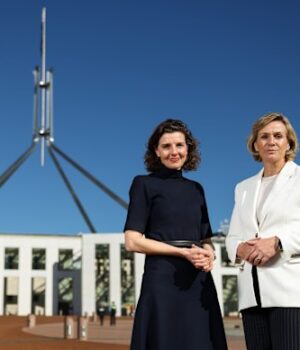
Teal independents Zali Steggall and Allegra Spender will form a new political party, Community Strong Australia, in a much-anticipated move set to further destabilise the two-party system, and an attempt to grab disaffected One Nation voters.
Community Strong will seek to exploit Australia’s political upheaval, as well as circumvent new donations laws that disadvantage independents, to establish a new stronghold in the Senate.
But the leaderless party, which is not currently taking funding from Climate 200, is a high-risk strategy, as all other teal MPs have declined to join.
“This is a centrist party, not a centre-right replacement,” Steggall told this masthead. “It is not a life raft for the Liberal Party. They have done their own damage to their own movement.”
Spender said she had consulted her community and donor base before joining the party.
“A lot of people feel politically homeless right now and very frustrated with the major parties’ ability to listen and deliver,” she said.
“People have come up to me in the street and said, ‘We hope you guys do build something together.’ I’ve had emails from all around the country.”
Papers to register Community Strong Australia as a party were filed on Wednesday with the Australian Electoral Commission, along with the party’s constitution, which allows its parliamentarians to vote as they choose on all matters except providing supply and confidence to a government.
However, there is a requirement to advocate for the party’s “policy pillars” – sensible economic management, climate action, equality and integrity.
The party will have no leader; instead, “parliamentary leaders will collectively lead”.
If the application is accepted by the AEC, party registration usually takes about three months.
“I strongly believe it is out there, an appetite for a different model,” Steggall said. “I don’t disagree that it’s a risk. That’s why I only have one colleague standing with me.”
Pollster Kos Samaras, who has consulted community independents about the appetite for a new party, said that “a number of people who are currently voting for One Nation – not an insignificant number of them – will switch to an alternative if it’s a serious one.
“They are sitting on One Nation in lieu of something else. At the moment, there is only one product on the market,” Samaras said.
“If there is a second one, it will hit the vote of One Nation just as much as it will hit any other established political party, including the Greens.”
How much support Community Strong Australia can garner is untested.
Steggall was enormously successful as the first “teal” candidate, winning the prize Liberal seat of Warringah on Sydney’s north shore from former prime minister Tony Abbott at the 2019 election.
Spender took Sydney’s blue-ribbon electorate of Wentworth from Liberal Dave Sharma in 2022 and increased her margin at the 2025 election.
But Community Strong has no candidates lined up yet and has not settled its policies. It would need five parliamentary members to qualify for “minority party” status.
Steggall and Spender hope other independent MPs may join Community Strong after discussing the proposal with their communities.
Bradfield independent Nicolette Boele and Mackellar independent Sophie Scamps have been consulting supporters and voters in their electorates on the idea.
The remaining two lower house teals – Victoria’s Kooyong MP, Monique Ryan, and WA’s Curtin MP, Kate Chaney – have ruled out joining the party.
Climate 200, the controversial big-money donor to many teal campaigns, is not involved in Community Strong, although Steggall did not rule out taking future donations from the political funding vehicle, headed by Simon Holmes à Court.
“Climate 200 is not part of this. They are informed of Allegra’s and my decision. There is no agreement over future funding,” Steggall said. “It’s partly because too many in the media will jump to assume control or influence from them.”
Steggall said the measure of the new party’s success would be on election night 2028.
“It will look like an increased presence in the parliament,” she said. “It might cost me politically. It might mean that’s it [for me]. But I think the moment in Australian politics is worth the risk.”
As a political party, Community Strong will benefit from new electoral donation laws that come into force on January 1 next year that will leave many independent candidates worse off than those from a party.
Individual candidates can now spend no more than $800,000 on their campaigns, but parties are also able to tap into their national campaign budget, which is capped at $90 million.
The donations changes were “a major-party stitch-up”, Spender said.
“I remember being reassured by one Labor person … that ‘Don’t worry, incumbents will be fine.’ But I believe in competition. If they construct something that means innovation and competition is harder, I have a problem with it.”
The laws were a factor in the decision to launch Community Strong, Spender said, “but to be honest, I would be doing this anyway because it’s about providing structure, which you need for things like the Senate”.
Senator David Pocock has insisted he will remain independent.
Community Strong wants to have candidates elected to the upper house, where its members could have greater clout if they held the balance of power.
Steggall said she first considered the idea of a party of independents in 2020, when she introduced her private member’s bill, the Climate Change Bill 2020, while Scott Morrison was prime minister.
“I saw the limitations of being one vote out of 150 … the limitation of our current movement, it’s our lack of impact in the upper house,” she said.
Spender notes that the independent candidate in the Farrer byelection, Michelle Milthorpe, received 42 per cent of the two-candidate-preferred vote, losing against One Nation candidate David Farley.
“The party structure would give support for those communities, where they want to have that representation, and the Senate gives them that opportunity,” she said.
Steggall and Spender believe the Community Strong structure – an “umbrella” party with no branch members and no obligation to vote along party lines – will fill a gap in Australian politics, one currently driving a surge in support for One Nation.
Steggall acknowledged that Community Strong would be unlikely to attract the “core traditional voter of One Nation” but believes it could pick up disengaged voters fed up with Labor and the Coalition.
“There are views held by One Nation voters that I don’t hold, and my community doesn’t hold,” Steggall said.
“But if they’re looking to major parties, rather than ‘wreck the joint’, let’s come together to build a different system. That’s my pitch. Be part of something different and new.”
Under the proposed party structure, Community Strong will have no ordinary branch members.
Steggall said the party’s constitution is “community-centric and [avoids] the pitfalls of the party model, which is the party whip, central control and branch stacking”.
“We don’t want to replicate the mistakes of the Liberal Party – factional power brokers who control the MPs above the communities,” she said.
Only parliamentarians and pre-selected candidates will have member status, with voter input coming via a community engagement committee.
In the case of a dispute over supply and confidence, a super-majority of votes would be required to decide the issue. However, given that the membership only comprises Steggall and Spender, the issue is moot for now.
Steggall, a former Olympic skier, said her sporting background had taught her that “staying still and doing the same thing is not really an option.
“You have to constantly reassess your approach and whether the field of play has changed. What is your strategy going into the next contest?” she said. “I have definitely come to the conclusion that it will be better to go to the next election under a different proposition.”
Spender said the plan was “to start small, with humility, and grow from there”.