

source : the age
A Melbourne fintech group which partnered with RMIT university to “develop the next generation of green cryptocurrency” is being overseen by two former top executives within the collapsed crypto empire behind an alleged $2.8 billion Ponzi scheme.
The connection between blockchain company CloudTech Group and the failed HyperTech conglomerate – founded by notorious Melbourne crypto figures Ryan Xu and Sam Lee – has raised questions about the university’s vetting processes before entering into sponsorships.
Among the startling number of accusations levelled against the company, US prosecutors allege that HyperTech ran a multi-level marketing scheme, siphoning a “staggering” $US1.89 billion ($2.69 billion) from customers around the globe between June 2020 to November 2022.
Many of the former executives, promoters and employees of HyperTech appeared set on distancing themselves from the collapse after the crypto empire crumbled in 2023 under the pressure of worldwide scrutiny, devastated investors, looming criminal charges, and online sleuths determined to hunt down those they deemed responsible.
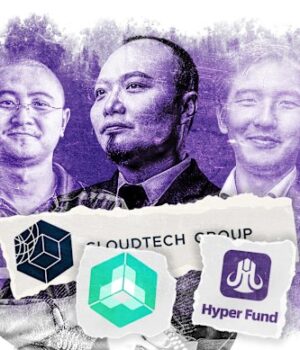
But this masthead can reveal that two of HyperTech Group’s long-time executives, Kaiyu “Kevin” Chen and Andrew Wasylewicz, have been overseeing blockchain start-up CloudTech Group, based in South Melbourne.
The pair is not accused of any wrongdoing and have not been investigated for their involvement with HyperTech. They were part of HyperTech’s inner circle, involved in the group’s vast multinational operations from its infancy until its eventual demise.
The rise and fall of HyperTech
A decade-long trail of corporate chaos has followed Melburnians Lee and Xu since the launch of their first business, Blockchain Global (formerly known as Bitcoin Group), in 2015. A series of ventures that began with a misleading prospectus has devolved into missing millions, lawsuits, and accusations of suspected criminality.
Their group, HyperTech, controlled a corporate web that spanned the globe, including investment firm Collinstar Capital, the failed cryptocurrency HCash, the alleged investment platform scam HyperFund, and the collapsed, ASX-listed Blockchain Global.
HyperTech promoted itself as a “diversified blockchain technology services group” on a mission to “disrupt entire industries by pioneering the world’s most comprehensive digital finance ecosystem”.
The group began their ambitious mission by founding Blockchain Global, the operator of Australia’s first and popular cryptocurrency exchange, ACX Exchange.
A year after ACX Exchange launched, the group unveiled its new cryptocurrency, HCash, pouring millions into research partnerships with Monash University and Hong Kong Polytechnic University. The coin’s price mirrored the lifecycle of what’s known in the crypto community as a “dead coin”: an explosive, brief spike in value in mid-2019 followed by an equally swift crash. By 2022, it was entirely worthless.
HyperFund (also known as Hyperverse), launched in 2020, was the group’s retail investor platform. It positioned Xu and Lee as the titans of a vast empire that created successful companies like HCash and Blockchain Global. Among its many pitches to prospective investors was the claim that it was heavily involved in “large-scale crypto mining” – a key revenue source that supposedly guaranteed lucrative returns.
“HyperFund, however, was a pyramid and Ponzi scheme. HyperFund had no real source of revenue other than funds received from investors,” a US lawsuit against Lee launched by the US Securities and Exchange Commission alleged.
By 2021, HyperTech and its various companies were beginning to unravel. After HyperFund’s thousands of investors were blocked from withdrawing their funds, financial watchdogs in the UK, New Zealand, Canada and Germany sounded the alarm. HyperFund’s chief executive Steven Reece Lewis turned out to be a paid actor. Some lost their homes, their life savings.
Blockchain Global spectacularly collapsed in Australia that same year owing creditors as much as $58 million. Public examinations in the Supreme Court of Victoria later revealed that the group moved hundreds of millions of dollars out of customer accounts, funnelling the cash into obscure investments, paying off a senior staffer’s mortgage, and siphoning funds directly into personal bank accounts. Years after the collapse, liquidators are still fighting to claw back funds for out-of-pocket creditors.
Lee left for Dubai after Blockchain Global’s collapse, and in 2024, the US Department of Justice indicted him on fraud charges related to HyperFund. He has strenuously denied the allegations levelled against him.
Xu, who was not charged by US authorities or any other authority for his role as Hypertech co-founder, on his own admission, is staring down potential criminal charges in Australia, as he remains under investigation by ASIC for his role as Blockchain Global director. His whereabouts are unknown.
‘My friend Ryan’
Just a few months before Blockchain Global collapsed, Chen founded blockchain start-up CloudTech Group in Melbourne.
Chen has held various titles across the HyperTech Group, claiming to be Collinstar Capital co-founder and executive director, HCash Foundation treasurer and, briefly, a Blockchain Global director.
His ties to HyperTech stretch back to 2015, yet any mention of the firm has been wiped from his corporate profiles since the multinational drew the ire of investors worldwide.
When this masthead asked about Cloudtech’s connections to HyperTech, Chen said he had never heard of HyperTech and denied any involvement. He hung up and did not respond to repeated attempts at contact.
His lawyer, Tisher Liner FC’s Michael Fetter, later provided a three-page statement denying any association with HyperTech.
“Our client has never been a shareholder, director, officer, executive, employee, consultant, advisor, or customer recruiter of the group.”
He also denied any association between CloudTech and HyperTech: “Specifically, there have never been any ownership interests, common directors, shared employees, funding arrangements, commercial agreements, service arrangements, joint marketing activities or customer-sharing between the two companies.”
The blockchain believer had not always been shy about his former business associations. In a 2021 interview – months before the collapse of Blockchain Global – the CloudTech founder credited Xu for his introduction into the world of crypto.
“In the year 2013, I meet my friend Ryan, and he introduced me to the philosophy of Bitcoin,” Chen said. As the story goes, in 2015, he, Xu and others co-founded HyperTech’s Collinstar Capital, an investment management firm that pumped cash into the group’s various projects, including HCash.
Chen’s lawyer now claims he joined in 2017, and did not hold any formal executive position in Australia.
“Several individuals would refer to themselves as ‘Collinstar founders’ or ‘Collinstar partners’, often based on business dealings or informal approval from Ryan Xu. This was common within the blockchain industry during this period,” the statement reads.
Chen’s lawyer said he served as HCash Foundation’s treasurer for two years. “During this period, Mr Chen’s responsibilities were limited to financial record-keeping and accounting matters. Ryan Xu would occasionally defer to our client’s approval when declining certain investment requests.”
He denied having any involvement in “technical management” during this time, nor exercising any broader authority or control over project funds.
Chen was brought on board to the ASX-listed Blockchain Global to “assist with corporate administration”. According to ASIC documents, he served as director from March 2019 to June 2019. His lawyer claimed he only worked there for less than one month, before resigning after a dispute with a fellow director. “Our client’s involvement was extremely brief and limited in nature.”
Chen and Xu joined the board of a Malaysian public company, Country Heights Holdings, in 2020 and proudly stood beneath a promotional sign that read: “The first public listed company in Malaysia to accept crypto.” They resigned on the same day in 2022.
Chen now claims to have met Xu in 2016: “Their relationship initially began as an investment relationship and later developed into a business partnership and personal friendship.
“They both remain in regular contact and continue to be friends,” the legal letter said.
On social media, both men use avatars from the iconic NFT CryptoPunks collection, a digital art series of pixelated characters that have commanded prices as high as $US11.8 million.
Chen’s lawyer said his client “may appear” in photographs with Xu at HyperTech or wider industry events, but these photographs do not establish “ownership, management, operational involvement, promotion or endorsement on HyperTech Group”.
Chen lives in a multimillion-dollar Brighton mansion with his wife and kids. His wife, who was not involved in the Hypertech Group, is the director of Cloudtech’s major shareholder, which owns an 86 per cent stake in the company’s parent entity.
Also in Cloudtech’s atmosphere is another trusted insider and avid proponent of HyperTech, Andrew Wasylewicz, who held several executive roles, including the chief operating officer and chief marketing officer of HCash.
Wasylewicz attended HyperTech board meetings, speaking at the group’s extravagant promotional events, and spruiking the company. “There’s such a team and experience behind the HyperFund that we’re very confident that this will be the next big thing,” Wasylewicz said at the official launch.
At a 2020 Hong Kong “Hyper Community” gala, Wasylewicz donned a Spider-Man suit with faux muscles, performing a karaoke rendition of Coldplay’s Viva La Vida in front of an adoring crowd, while sharing the stage with his fellow crypto spruikers.
It’s not clear when Wasylewicz left the crypto group; he was last seen on its website in December 2023, the same year its Australian entity was deregistered.
Wasylewicz joined Chen in 2023, when he was appointed director of a CloudTech subsidiary, expanding to a second in December 2025. Despite attending events including the company’s team Christmas party and end-of-financial-year celebrations, there is no mention of Wasylewicz anywhere on CloudTech’s websites.
Wasylewicz did not respond to requests for comment. Several CloudTech employees were contacted but did not respond.
Million-dollar deals, university projects
CloudTech has made a splash in the Melbourne tech scene since its founding.
In 2022, it inked a lucrative partnership deal with RMIT to establish a joint research laboratory, the GreenCryptoLab, committed to “develop the next generation of green cryptocurrency technologies”. Last year, the Southbank company brought in ex-bankers to head up the development of a “stablecoin”.
The industry has been seemingly impressed by their work – former Judo Bank managing director Mandy Jiang, the group’s chief financial officer and executive director, was shortlisted for the 2025 Women in Finance Awards.
Last year, CloudTech made headlines for raising $14 million from its Series A funding from six anonymous investors. Business publication Capital Brief reported that $11 million of those funds came in the form of bitcoin and cryptocurrency stablecoin USDT.
In September, CloudTech announced a $3 million investment into the now-delisted Assetora, formerly known as DomaCom. The retail investing platform rebranded following a series of articles in The Australian Financial Review.
CloudTech also owns AANG Gallery, a South Melbourne studio that features non-fungible tokens, or NFTs – blockchain-based digital art designed to be unique, traceable and verifiable, akin to a digital certificate of authenticity.
A RMIT spokesperson declined to comment on questions put to the university, including whether it would launch a review into the partnership. They also declined to provide their vetting process policy.
An RMIT insider, who refused to go on the record, said the university was unaware of the links and would only review the partnership if there were reputation concerns.
The tertiary education union’s Joo-Cheong Tham, also a Melbourne University law professor and integrity expert, warned that without proper governance, corporate partnerships can erode the integrity of universities.
Speaking generally of such partnerships, Tham said: “[They are often] shrouded in secrecy with insufficient accountability for whether they are in pursuit of the core public mission of universities.”
An ASIC spokesperson said their investigation into Xu and Blockchain Global is ongoing and could not comment on specifics.
The Business Briefing newsletter delivers major stories, exclusive coverage and expert opinion. Sign up to get it every weekday morning.
 Carla Jaeger is a journalist for The Age. Got a tip? Email carla.jaeger@theage.com.au or message carlajaeger.62 on Signal.Connect via X or email.

