Source :- THE AGE NEWS
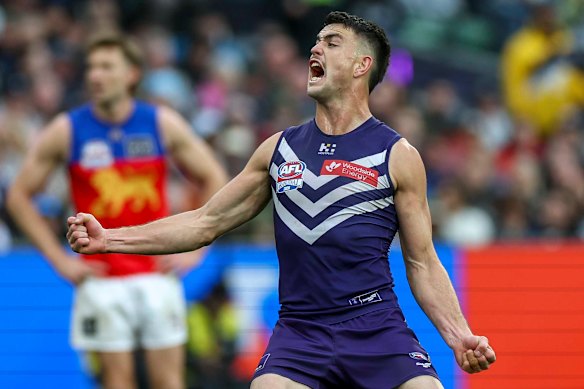
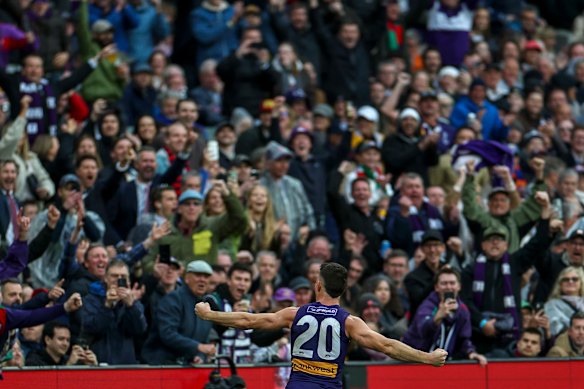
At 5:05pm on Saturday, September 26, Fremantle forward Patrick Voss kicked a goal to put the Dockers 17 points up in the AFL grand final and took off around the boundary to celebrate.
There were four minutes and 18 seconds remaining in the match.
After taking a 10-point lead into three-quarter-time, Voss’ goal had opened up the biggest margin of the desperately tight contest. The Dockers were on the cusp of winning their first premiership, having entered the competition in 1995.
History was on their side. Only one team this century had led at the final break of the grand final and lost.
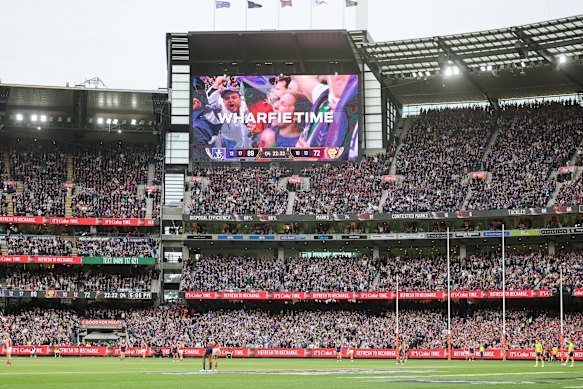
Fremantle officials decided the moment had arrived to unleash “Wharfie Time” on the MCG for the first time.
It was the third time in the 2026 season they had pushed the button, and just the 11th time it had been given a run.
The Dockers had never used “Wharfie Time” when holding a bigger lead, but such calls were not made on a whim.
The criteria before any activation – which the executive had developed in consultation with all parts of the club, including the football department – had been met.
By Saturday, after 10 previous implementations for five wins, a draw and four losses, the guidelines surrounding what would prompt the activation of “Wharfie Time” were refined.
It could only be activated within the final five minutes of the match – this wasn’t the case until this season – and at a crucial juncture in the game with the scores close.
The club had engaged with the football department and players to gain their imprimatur throughout.
At Optus Stadium, the decision could be made whether the Dockers were in front or behind on the scoreboard, but for the first time – because it was a grand final and needed AFL approval to become part of the day – “Wharfie Time” could only be activated after a Dockers goal.
They had lobbied the AFL hard all week for the right to deploy it. Everyone was on board and the process sprang to life.
A message from the Dockers’ hierarchy (the exact person who said “go” remains clouded in secrecy but CEO Simon Garlick, who played 189 games including the 1996 grand final with Sydney, supported the call) went to a club official who had already arranged at half-time to be in proximity to the AFL official responsible for getting the message to Lumen8 Media, the company responsible for activations at AFL venues.
The ground grumbled to life as bells rang, Dockers supporters went nuts and purple lights ran around the MCG perimeter.
On Fox Footy, Hawks legend Jason Dunstall immediately recognised the danger. “There is time on the clock,” he said.
In the middle, Brisbane Lions champion Josh Dunkley began waving his arms around in an attempt to rally the troops, who were ready to meet the moment.
In the final team meeting on Friday, assistant coach Dale Morris had shown a picture of the crowd erupting at Optus Stadium and played the “Wharfie Time” audio.
The players agreed that if they heard that sound it would be the signal to charge back at the opposition. Kai Lohmann compared their approach to throwing down a reverse Uno card.
To most Victorian football fans, the experience was new, but for Dockers loyalists it had been anything but a victory lap.
“[It is to] essentially lift the crowd in a critical moment late in the game,” Garlick explained on SEN WA on Tuesday.
An abridged version had sprung to life for the first time against the Lions on August 6, 2023 when a Michael Frederick goal had dragged the Dockers within two points with 1:09 left on the clock.
The bells, which signal the start of AC/DC classic Hells Bells, had rung around Optus Stadium and the phrase “Wharfie Time” had appeared with graphics of a boat crashing through purple waves.
TV commentators did not mention it and, although the crowd roared, it did not lift Fremantle over the line. The Lions hung on to win the match by three points.
The first four deployments of “Wharfie Time” had hardly created an expectation it could turn a game the Dockers way. Pushing the button when the Dockers were trailing had only led to one draw (against Collingwood in 2024) and three losses.
But it had created exactly what the Dockers wanted, a fan experience like no other.
Shrouded in mystery as to when and how it was implemented, fans attending Optus Stadium reacted with fervour every time the bells tolled, once in 2023, twice in 2024, and five times in 2025 before it became embedded in the national consciousness this season as the Dockers attracted more than 50,000 fans to home games 10 times in a row.
The first time casual observers from eastern states noticed “Wharfie Time” was when it sprung to life during a Thursday night match against Hawthorn in round nine when Frederick kicked a goal to put the Dockers within four points with four minutes, eight seconds remaining.
The Dockers kicked a goal 19 seconds later as they ran away to win by 15 points.
It was the first – and the only time – the activation of “Wharfie Time” when the Dockers were trailing had ended with Fremantle in front at the final siren.
Suddenly the football world recognised its potential power.
Hawthorn was asked how they would respond if they faced Wharfie Time in the qualifying final. Word leaked out that it had been mentioned in their preparation.
Dockers fans and the media were calling for it to be activated more often than it had been, such was the atmosphere it created.
But the Dockers held firm between the round-nine thriller against the Hawks, and when they pushed the button with 78 seconds remaining in the semi-final against Geelong. Their lead was eight points then, and they won by 14.
But no team has been capable of rising from the canvas like Chris Fagan’s men.
And the bells were a trigger for this Lazarus-like Lions line-up.
As one football observer would later say, “the Dockers thought they were lighting a victory cigar, but they were lighting an exploding cigar”.
When Charlie Cameron kicked a goal within 23 seconds of “Wharfie Time”, Dunstall was more strident in his view: “I just reckon it is the wrong time to play [it],” he said.
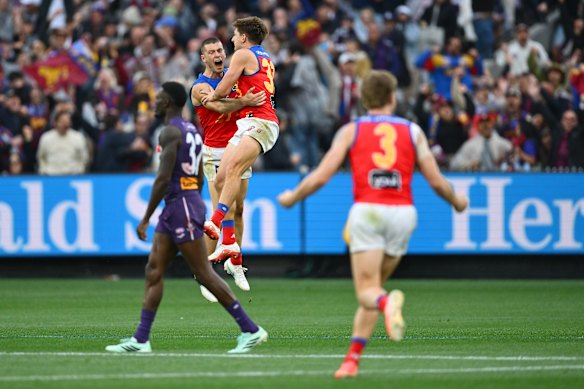
Three minutes later, the Lions led the grand final, and they were premiers by seven points at the final siren.
From the Dockers’ coach Justin Longmuir to their football manager Joe Brierty, to Garlick, there is no connection between the deployment of “Wharfie Time” and their capitulation in the final 248 seconds.
“I don’t think that has anything to do with it,” Longmuir said.
The Dockers have too much respect for the Lions’ capability and for their own football ability to think bells and whistles affected the result, although Garlick accepts that after such a heartbreaking loss people will cling to one reason – an umpiring decision, a dropped mark, the positioning of a player, or even “Wharfie Time” – as an explanation.
He doesn’t buy that theory, but he respects the fans enough – at the time of publication, a poll in The Age showed 65 per cent of those polled didn’t want to hear “Wharfie Time” again – to understand their views will need to be canvassed before any decision is made on whether to continue with the activation in future. Victorian premier Ben Carroll even used the term in a political soundbite on Monday implying it meant going the early crow.
“I think it’s probably raw at the moment. Our fans love ‘Wharfie Time’; they just lost a grand final in the most heartbreaking of ways. We are not about to throw out things who make us who we are. We will work through that in the fullness of time,” Garlick said. “It is a fan activation tool. It is not a strategic, performance-based element … we will just work through it with our fans, we always take their lead.”
Whether it lasts or not remains to be seen.
What is certain is that ‘Wharfie Time’ is the most famous sporting activation tool in Australian sporting history, a moment of football folklore the Dockers will need to overcome to win the club’s first premiership.
Get around our AFL finals coverage
Keep up to date with the best AFL coverage in the country. Sign up for the Real Footy newsletter.