
Source : the age
If you’re heading to the cinema or just your couch, our reviewers have you covered with the new releases you need to know about each week.
And don’t forget to sign up to our Screening Room newsletter for must-see movies, interviews and the latest news from the world of film. Popcorn not included!
M (108 minutes)
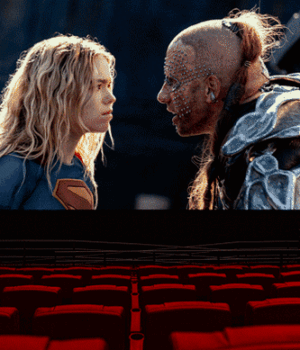
Let’s see if Supergirl’s time has finally arrived. Australian director Craig Gillespie’s new film is out to make her a star. In this story, her Kryptonian cousin, Superman, has been relegated to the role of a sedate bit player.
She has had an unhappy history. She’s been tossed all over the DC Comics multiverse, enduring personality changes and odd alterations in her origin story. She’s been cloned, brainwashed, killed and revived. Now at last, the spotlight has swung her way.
Cast in the role is another Australian, Milly Alcock, who made her screen breakthrough in House of the Dragon, and her Supergirl is a contrarian – a disaffected twentysomething with messy blonde hair, a hoodie and a lot of swagger. She’s been orphaned, she’s seen her planet die and she finds it very dull staying on Earth with Superman and his alter ego, Clark Kent. He sees the good in people, she says, while she sees the truth.
PG (90 minutes)
For thousands of years, a tribe of immortal outsiders have been wandering the Earth, seeking a dark lord who will give their lives meaning. It sounds like a ponderous allegory, which Minions & Monsters might imaginably have been if it wasn’t a film about Minions. But the French writer-director Pierre Coffin, who co-created the little yellow maniacs in the first place, goes out of his way to let us know he has nothing serious on his mind.
While the Minions may be eternal underdogs, they bear no resemblance to any downtrodden group in the real world. That is, unless you count young children: the trademark Minion gibberish incorporates fragments of several languages but mostly sounds like the babble of an excited toddler.
The somewhat disjointed quality of Minions & Monsters is fitting provided we take it as a fantasy conceived by the Minions themselves. That would also explain why it contradicts the origin story implied in the Despicable Me films – that the Minions were manufactured in a lab by their crazed present-day boss Gru (Steve Carell, absent here).
M (117 minutes)
The Ice Tower is an updated version of Hans Christian Andersen’s The Snow Queen and it takes you a long, long way from Disney’s Frozen. It hasn’t much to do with the fairytale either but it is about an innocent and the Queen is as cold and manipulative as Andersen’s original.
For its style, however, French-born writer-director Lucile Hadzihalilovic looks to 1930s expressionism and the dreamlike theatricality of Michael Powell and Emeric Pressburger’s work. It’s a film of significant pauses, obsessive attachments and deliberately cryptic encounters. It demands your patience.
The action takes place in the 1970s in a town in the French Alps. A film company is making a production of The Snow Queen with Cristina van den Berg (Marion Cotillard), a notoriously temperamental actress, as the Queen. And Jeanne (Clara Pacini), an orphaned teenager, happens on the film studio one night after running away from her foster family in a mountain village.
MA (97 minutes)
The potential for a charming comedy-drama exists in Glenrothan and I’m sure the right director could have brought it out, especially with a free hand to rewrite David Ashton and Jeff Murphy’s script.
The premise isn’t terribly exciting but as a starting point for a character study it’s workable: two estranged brothers reunite in the Scottish Highlands after spending most of their adult lives apart.
One of them, Sandy (Brian Cox), has stayed put all this time in the village of the title, ageing into a crusty old codger and devoting himself to the whisky distillery that’s been in the family for generations.
MA 15+ (122 minutes)
The Death of Robin Hood requires you to surrender your illusions at the door. Forget about the Robin Hood who robbed the rich and gave to the poor. Forget about the Lincoln green outfit and the feather in the cap.
There’s not even a forest and there are certainly no merry men. This Robin is a grizzled recluse played by an unrecognisable Hugh Jackman draped in animal skins with a voluminous beard and a tangle of hair. He’s wandering the wintry crags of some wild and isolated part of England’s north and he’s very bitter about the life he’s led and the legends that have grown up around the acts of violence he’s committed.
I took time to come to terms with this idea. After all, Robin has already died on screen in more romantic circumstances. In 1976, the British director Richard Lester made Robin and Marian, starring Sean Connery and Audrey Hepburn as mature lovers reunited for the first time in years. Marian has become a prioress and the mortally wounded Robin is taken to the priory to spend his last days. In the end, they die together after confessing their love. If Robin had to die – and I’m not convinced – I found this a much more satisfactory arrangement.
M (100 minutes)
Kate Moss’ executive producer credit on Moss & Freud may be no more than honorary. But it might also help account for the mildness of this double portrait, directed in a deceptively hectic style by first-timer James Lucas (who hails from New Zealand, where parts of the film were shot).
At the height of her supermodel fame, the fictionalised Moss (Ellie Bamber) is depicted as a free spirit living large, filling the gaps in her schedule with drug binges and S&M. Sensing the need for a steadying influence, she finds one in the distinguished painter Lucian Freud (Derek Jacobi) who is keen to paint her if she can agree to his strict terms: three visits to his studio per week, arriving on the dot of 7pm.
Aged about 80, Freud inhabits a world remote from hers but is no less of a sacred monster. He’s concerned art comes ahead of all human relationships, though his own colourful past includes two ex-wives and a substantial number of offspring.
MA15+ (88 minutes)
We’ve seen the evils of conversion therapy before on screen, depicted as a so-called cure for homosexuality. In 2018 Joel Edgerton wrote, direct and appeared in Boy Erased, one of the best, with Nicole Kidman, Russell Crowe and Lucas Hedges as a teenager sent off to a camp for “treatment”.
But Leviticus takes the punishment to a new level. Australian writer-director Adrian Chiarella’s film embraces the current craze for horror movies by bringing the supernatural into the picture. The film’s success at the Sundance Festival has earned him comparisons with fellow Australian directors Jennifer Kent and Danny and Michael Philippou, who are all discovering that you can step into the occult a la Stephen King and Stanley Kubrick but with only a fraction of their budgets.
Arlene (Mia Wasikowska) and her 17-year-old son Naim (Joe Bird) have moved to a dreary stretch of Victorian countryside because Arlene has joined a Pentecostal church whose parishioners have come together in a nearby town – news which immediately sets alarm bells ringing.
G, 102 minutes
No one strictly needed a Toy Story 5, except possibly Disney’s shareholders. Still, the bottom line isn’t necessarily the only reason for keeping Pixar’s flagship franchise alive: the pathos of the premise becomes ever more evident as time goes by.
Children grow up, but their toys stay the same, albeit less shiny and exciting than when they were brand new. While a lucky few are passed down to the next generation, the rest are liable to be packed away or thrown out – which is what the toys in the Toy Story films live in fear of – though the subject of toy mortality is rarely confronted head on.
All things considered, the legacy characters in Toy Story 5 are doing well. Woody, the cowboy ragdoll (voiced by Tom Hanks), no longer belongs to any particular child, but seems content undertaking toy search and rescue missions in the company of his true love, Bo Peep (Annie Potts).
(MA 15+) 109 minutes
Tuner is a very clever thriller about piano tuning and safe cracking – skills which turn out to have a lot in common. And at its heart is a warm and funny relationship between rising British star Leo Woodall and Dustin Hoffman whose glittering career has reached its twilight stages.
Hoffman’s Harry Horowitz is a former jazz musician who has taken on piano tuning in his retirement while Woodall’s Niki White, the son of one of Harry’s oldest friends, is his colleague, having resorted to piano tuning after dealing with a cruel joke perpetrated by nature. His highly promising future as a concert pianist has been stymied by a severe case of hyperacusis. In simpler words, he has become so sensitive to sound that he must wear ear plugs to dull loud noises just to get through the day. Making music is now impossible but he’s a highly accomplished piano tuner.
As he and Harry drive around the city, tending the pianos of the rich and famous, he’s learnt to hide his frustration, consoled by Harry’s jokes. But one day, his uneventful life changes. Harry has forgotten the combination to the little safe he keeps at home and Niki helps him out by patiently working the numbers until the safe clicks open. A plausible coincidence then brings his new talent to the attention of a trio of Israeli criminals led by Uri – played by Lior Raz, star and creator of the television series, Fauda. And when Harry lands in hospital, unable to pay his medical bills, Niki reluctantly consents to assist Uri and his accomplices with a succession of safe robberies.
(M) 101 minutes
Somehow, I can’t get into the romance of truffle hunting. Nor am I automatically tempted by the prospect of a film set in the Langhe, a region of Northern Italy famed not just for its white truffles, but for its wineries and rolling hills.
An ideal venue for a destination wedding, no doubt, assuming you’re well-heeled enough to accept the invitation. But no matter how pretty the scenery, movies that double as tourism campaigns have a tendency to be short on drama.
Such were my thoughts going into Trifole, the second feature from the young Italian director Gabriele Fabbro – and for quite a while it seemed as if all my worst fears were coming true. The traditions of the region are personified by Igor, a staunch 90-year-old truffle hunter played by Umberto Orsini, a fixture of Italian cinema since the days of La Dolce Vita.