

Source : the age
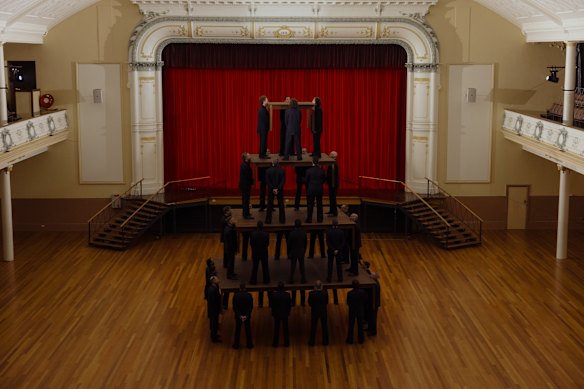
The longer I look at it, the less sense it makes. In front of me there is a stack of four tables, forming a pyramid several metres high. None of the tables have legs. Instead, they are held up by rows of men; neatly dressed, arms either lightly crossed or hanging by their sides, standing perfectly still.
The only sounds are those of a crowd trying to stay quiet; suppressed coughs, the creaking of chairs and occasional footsteps as people move to different vantage points. There are no whispers in the audience – we’ve been warned not to distract the performers. And there is no chatter at all from the men – how could there be? Their teeth are firmly clamped on the edges of the tables.
It’s increasingly rare to have moments where your mind isn’t being bombarded with stimulus. Conversation, tasks, TV, the endless scroll, planning, chores; on and on it goes. Good, bad, stressful and fun in waves, yes, but pretty much unending.
Staged as part of this year’s Dark Mofo, Stasis by Ruben Bellinkx, however, is an invitation to stop and think; to focus on just one thing. In the dimming light, without my phone, without demands on my time, with only the scene in front of me, my mind immediately started flailing about, trying to give itself a task (count the men! Figure out how it is done!) before finally settling in and simmering down.
Appreciation of an artwork is a collaboration between artist and audience, and in a week when Elon Musk became the world’s first trillionaire, in the wake of what now feels like an endless stream of artists being penalised for their politics and activism, a tableau of men who pay for their place at the table with silence, who hold one another up to create a final platform for someone who isn’t there, hits hard. We are building our own cages.
This year’s Dark Mofo doesn’t have a headline act and I think it is stronger for it. The Hobart-based arts festival brings together visual art, performance, music and a spectrum of things that lie in between.
Scattered across the city are a number of experiences and spaces that invite intense reflection. Fakahoko is a performance work in which Kalisolaite ’Uhila first pours a trail of paint down a canvas, then pulls a chain through it, the only noise the muffled thumping of metal across fabric-covered concrete. In Basilica – a deconsecrated church – is Gabriel Lester’s work The Sky Caving In. Across the course of festival a gentle dusting of ash-coloured flakes flutter down over the pews, building up and up as the days go on.
Further away, at the Museum of Old and New Art (Mona) is a newly installed work by Swiss artist Julian Charrière, Breathe. In it, oxygen is pulled from ancient iron ore and filtered into a room where visitors enter one at a time. Before going in you are given simple instructions; don’t touch anything but the chair, and please resist the urge to suck the air directly from the small tube sticking out from the filtration system.
When I enter (after first causing a flurry of anxiety among the staff by accidentally turning left and almost entering the room with the scientific apparatus) my brain goes through the same process it does in Stasis. Do I take photos? Am I experiencing the artwork correctly? Should there be a gust coming from the tube? Is this thing on? Why does it look like a giant bong? And then I settle in. The concept is that we are breathing in oxygen that has never been breathed before. It’s a seductive idea.
The further you step back from the spout and towards the real world, however, the more our air all mixes back in together. Later that night, when I’m standing outdoors at the all-night party Night Mass: Dead End, I catch the scent of cigarette smoke and wonder how many lungs that air has passed through.
Dark Mofo’s program for the first weekend is a strong one, which at times is something of a poisoned chalice. The visuals at Purity Ring are nothing I’ve ever seen on a stage before. Clipping – headed up by Daveed Diggs – is a particular highlight. Gabber Eleganza kicks off with and maintains an energy level that feels illegal for an event at 6.30pm. But the packed schedule means that gigs overlap with one-off works of performance art; choosing one thing means you can’t experience another. But it’s a good problem to have.
The decision to make the Spirit of Tasmania V – one of the state’s two controversial new ferries – a key venue of the festival’s Dark Park is an interesting one. Beset by delays, cost blowouts, mistakes, and an expensive temporary berthing in Scotland, the ferries have been a source of scandal and political embarrassment. Now, however, the newly docked ferry is serving as an extension of the festival’s visual art hub. As an arts space, it feels like its potential isn’t fully realised. There are video works and a text-installation, but they feel almost secondary; overshadowed by the cavernous space.
The best use of the space is for the installation Perros Chaos by Lolo & Sosaku – best viewed from the above walkway, it’s a scene of chaos, populated by two performers accompanied by roughly hewn machinery that only fleetingly look like dogs or people. One machine jerks its way along the floor, while another whacks a car with a metal stick.
A macabre hanging figure occasionally grinds a cigarette into ash under the curve of metal that serves as its foot. “It’s a bit more spooky than I thought it would be!” a woman says to the child behind me.
Dark Mofo runs until June 22
Elizabeth Flux travelled to Hobart as a guest of Mona.
The Booklist is a weekly newsletter for book lovers from Jason Steger. Get it delivered every Friday.