

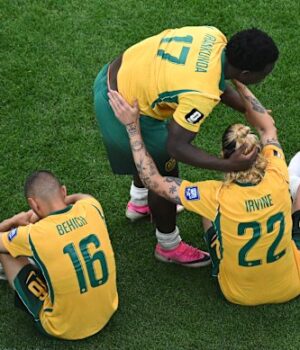
Source :- THE AGE NEWS
Dallas: In the afterglow of the Socceroos’ 2-0 win over Turkey a few weeks ago, Alessandro Circati said something that should still be ringing in the ears of Australian soccer’s decision-makers as they ponder their next moves.
“I don’t want to be the underdogs for the rest of my life,” Circati said.
“I want to be a team which everyone faces and is like, ‘Ah, we’ve got to play Australia’.”
He’s not alone. Judging by the response to Australia’s shattering World Cup exit against Egypt, Socceroos fans and players alike have had a gutful of gallant defeats. In the 48-team era, getting out of the group is no longer enough for anyone.
As Nestory Irankunda put it after the match: “That’s the way Australia should be. We should be pushing for more than that.”
So how do we get there? How do the Socceroos become a team that dictates a match, rather than one that habitually defers to the opposition? How do we gain the “respect” from the wider soccer world that coach Tony Popovic bemoaned was missing towards Australian teams? How do we stop “punching above our weight”, and actually move up a division or two?
These are questions that stretch far beyond Popovic, his tactics, his penalty shootout plans or his squad. They go to the heart of what kind of football nation Australia wants to become. These are not new questions; each time they have been raised in the past, the game always finds a way to avoid answering them.
So let’s finally dive in.
Popovic took a raw, inexperienced squad – he named some of the youngest starting tgeams at the World Cup – and gave them a defensive framework that made them capable of competing with anyone. For that, he deserves immense credit and scrutiny.
His blueprint was built on structure, discipline, organisation and an aversion to risk – and it worked, but only to a point, because those benefits came at the expense of others. To not take risks is also a risk. The Socceroos simply didn’t create enough in attack to unsettle their opponents and win games. In 300 minutes since the end of the Turkey match, there were zero goals scored by an Australian player, and few moments where anyone could argue that one should have been scored.
They were difficult to beat, but that made it difficult for them to win.
Popovic would argue that’s what he had to do to give the Socceroos the best chance of success, and that where they finished in this World Cup was in line with most realistic expectations. If we remove the rose-coloured glasses and look at where these players play their club football, and how often they play compared to their rivals, he may have a point.
Popovic got more right than wrong, and though we can – and should – quibble about the handling of the Egypt game, he probably extracted close to the maximum out of this squad.
But nobody will be happy if we’re saying the same things in 2030.
Australia now have players who are not only capable of playing a different way, but judging by Circati’s comments, are eager to do so.
Jordan Bos, Irankunda, Cristian Volpato, Lucas Herrington, Paul Okon jnr – these are not guys who think of themselves as plucky upstarts. They have grown up in a different Australia to the “golden generation”. They have all spent time at big European clubs, or are being chased by them right now.
This is the young core of a potentially special team, and if they make the right moves in their careers during the next World Cup cycle, and a few others follow in their footsteps, Australia will have a group capable of blowing off the ceiling.
Having penned a six-month contract extension to take in January’s AFC Asian Cup in Saudi Arabia – a tournament the Socceroos should be aiming to win, not just compete at – Popovic will have a short runway to prove he can evolve the team’s approach and make them a more damaging side on the ball, which they will need to be in Asia.
But if Australia want to fully realise Circati’s ambitions, it will take more than one coach and one tournament. It will take the entire game, and a level of expertise, strategy, investment and foresight hitherto unseen from Australian soccer’s leaders.
Inevitably, the discussion turns to philosophy and strategy. The Socceroos (and Matildas) don’t have one. Two decades after joining the Asian confederation, Australia’s national teams still do not have a clearly defined playing style to aspire to, which shapes the attributes of the players we develop and coaches we entrust them to. That is a damning indictment on the game’s leadership.
Instead, FA relies on the identity of the manager to determine the identity of the team, which makes continuity impossible.
A much-vaunted audit of the “talent development ecosystem” by FA, conducted last year, still has not been publicly released. The national curriculum isn’t even on FA’s coaching resources website; it says an updated version is being worked on, and that more information will be provided soon. It’s said that for months.
How can everyone pull in the same direction if we don’t have a compass?
Change is coming, apparently. So said Heather Garriock, FA’s executive director of football, who promised the work is being done – but her press conference in Dallas on Saturday morning (local time) did not reflect a federation with a true sense of clarity on what kind of team they want the Socceroos to be, other than a little bit more attacking.
In the absence of a senior technical director, Garriock is now the most important football voice in the Australian game, and there is huge pressure on her to deliver. Presumably, it is she who will soon sit in review meetings with Popovic to discuss his performance, seek explanations for his decisions and hold him to account.
But it is difficult to have faith in an organisation that has lost more than $20 million during the past two years, seems constantly on the brink of war with its own constituents, and hasn’t focused enough on the one thing that sits above them all, and ultimately governs everything they do: what happens on the pitch.
That is where all the attention needs to go next: on supporting the development of players to help create a better team and a prouder nation.
Circati’s words show where this generation has set its expectations. Now it’s up to the rest of Australian soccer to catch up.