

Source : THE AGE NEWS
President Donald Trump shot down the idea of new regulations on artificial intelligence after meeting at the White House with top industry executives and signing with them an agreement for industry self-regulation amid growing global concerns over threats posed by the technology.
Speaking on Tuesday after a luncheon with nearly two dozen Silicon Valley leaders, including Anthropic chief executive Dario Amodei and Nvidia chief executive Jensen Huang, Trump said existing laws would be enough to safeguard Americans from AI’s potential risks.
“I think I’m seeing tremendous self-policing. And they understand that they have to self-police,” Trump told reporters outside the West Wing.
Trump said the tech executives signed an agreement that is “morally binding,” without providing details, and floated the idea of a “committee” of roughly 10 people that would help “watch over the whole enterprise”.
“There’s a belief that there should be tremendous self-regulation, and we automatically have regulation with the Department of Justice, the FBI, all of that, but the self-regulation is very important,” the president told reporters in a brief appearance with his guests.
The agreement sets what House Speaker Mike Johnson described as a “voluntary” set of “commitments” by the industry to implement “robust internal controls and layers of internal and external review.” Johnson, who attended the meeting, said the text would be released later.
‘I think I’m seeing tremendous self-policing. And they understand that they have to self-police.’
US President Donald Trump
The luncheon at the White House was joined by other technology industry attendees including Meta boss Mark Zuckerberg, Palantir Technologies CEO Alex Karp and OpenAI President Greg Brockman. The decision to even engage on AI safety had appeared to mark a shift for Trump, who only last week rejected fears of catastrophic risk as “a hoax”.
Other industry attendees were expected to include Microsoft CEO Satya Nadella, SpaceXAI’s Elon Musk and Advanced Micro Devices’ Lisa Su, according to a list released by the White House. Vice President JD Vance, Treasury Secretary Scott Bessent, Commerce Secretary Howard Lutnick and White House Science and Technology Policy Advisor Michael Kratsios also planned to join.
Pressure to take action has increased following high-profile security breaches by rogue AI models that fuelled calls by Silicon Valley AI developers and world leaders for new standards on the technology.
Yet Trump’s remarks splashed cold water on the notion that his administration might move away from its hardened opposition to new government AI safeguards and become more open to new rules.
During remarks on Tuesday, Trump signalled his continued distaste for regulations.
“We have a very big lead, and we’re going to keep our lead, and it’s a very positive thing,” the president said, referring to his desire to maintain the US’s edge in the global AI competition.
“I will never stifle the growth of a technology that will be bigger than the industrial revolution,” Trump said earlier in the day at the unveiling of an AI chatbot, America.gov, intended to help Americans navigate government services. “We can’t stifle it, and we’re leading by a lot.”
The debate has posed a political conundrum for Trump, who has cast himself as one of the nation’s loudest champions of AI, arguing that its unfettered development is key to beating China and sustaining the US economy. But polls show Americans have rapidly become more wary of the technology’s risks, including job loss, higher electricity costs and major cyberattacks, threatening to put Trump on the wrong side of the issue ahead of the November midterm elections.
Trump has recently become preoccupied with AI’s name, suggesting he sees the controversy surrounding the technology as a branding problem more than an issue with its potential dangers. The president said on Tuesday he would sign an executive order later in the day renaming it “super intelligence.”
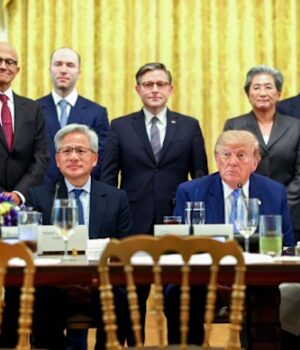
Shortly before the meeting began, Trump posted on his Truth Social network a guest seating chart that put Huang and Musk at either side of the president.
His desire to maintain close ties with the industry was also on full display. When reporters entered the room, the executives were lined up behind the president as if they were posing for a group photo and Trump gushed about their contributions to the US.
“The one thing that we all have in common is we love our country and we love the world, and we want to make sure it’s a safe place,” he said.
The president did appear to acknowledge growing public discontent with the AI rollout. He indicated that the companies in attendance would work more closely with local communities to ease concerns over the impact of new data centre construction. “They’re going to do things for the community that will be really financially beneficial and otherwise beneficial,” Trump said, without providing specifics.
The lunch took place after Trump met with Amodei on Sunday, bringing together two men at opposite ends of the AI safety debate. The late-night dinner marked their first private sit-down after months of rocky relations between the Anthropic chief and the administration over safety-related issues involving the company’s AI tools.
Amodei has long warned about AI’s existential risks, and he propelled the safety debate into the mainstream with a September 12 essay, promising to slow development of the most advanced models and urging more regulation. His pledge to pace development was embraced by his rivals, OpenAI CEO Sam Altman and Musk.
Highlighting those concerns, OpenAI said on Monday it would hold back a version of its Astra model while it establishes stronger safeguards.
Saachi Jain, OpenAI’s head of safety systems, said the in-development GPT-6.1 Astra model wasn’t as good as the company wanted when it came to “staying within scope and authorisation, and how it communicates back to the user about the type of work it’s done.”
Earlier this month, Johnson responded to dire warnings coming from within the AI industry by saying that Congress “potentially” will need to impose guardrails, though he cautioned it would likely take “some time” to fashion legislation with broad enough support to pass.
Ahead of the lunch, Johnson said he’d “been urging this meeting for a long time” and added he hoped it would lead to voluntary steps to mitigate AI risk, such as audits or other transparency measures.
“The leading minds need to get together at the White House and have this discussion,” Johnson said Tuesday on CNBC. The AI companies “have fiduciary obligations to their own corporations, of course, but we have a broader obligation to the people and to safety and to ensuring that this is done right and well.”
In the near term, US Congress is unlikely to act on any AI legislation. House lawmakers have already left town for recess and won’t return until after the midterms, and the Senate is preparing to begin its own preelection recess later this week.
Bloomberg, with Reuters and AP
The Business Briefing newsletter delivers major stories, exclusive coverage and expert opinion. Sign up to get it every weekday morning.


