SOURCE :- THE AGE NEWS
Washington: US President Donald Trump threatened to bomb US ally Oman if it “gets in the way” of reopening the Strait of Hormuz, while casting doubt on the possibility of reaching a new deal with Iran after their 60-day interim agreement expired.
Next week will mark six months since the US and Israel launched a joint attack on the Islamic Republic. Although the fighting has subsided, the US continues to impose a naval blockade against Iran, and a permanent deal to end the conflict and restore free shipping remains elusive.
In an interview with Fox News, Trump reportedly confirmed the existence of back-channel communications between the US and Iran’s Islamic Revolutionary Guard Corps, the hardline militants responsible for shooting drones and missiles at ships in the strait.
Iran and Oman – an American partner on the Arabian Peninsula, which sits across the Gulf of Oman from Iran – have been engaged in talks about management of the crucial waterway, as stipulated by the Memorandum of Understanding signed by the US and Iran in June. That agreement expired on Monday (Washington time).
At a news conference, Iranian foreign ministry spokesman Esmaeil Baghaei said talks with Oman continued. The process was taking longer, he said, as multiple countries were trying to influence the outcome. The parties have suggested an agreement was close for nearly two weeks.
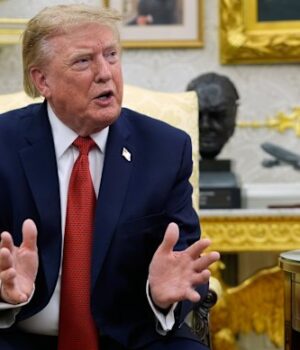
Trump told Fox News on Monday: “If Oman gets in the way, we’ll bomb the shit out of them.” Later, in the Oval Office, he struck a different tone: “I don’t think [Oman] behave very well, but we handle them.”
It is not the first time Trump has made such a threat, as Oman has previously countenanced the idea of setting up a tolling system in the strait with Iran.
He insisted November’s midterm elections were not a factor in his thinking, despite many Iran experts arguing that Tehran was trying to run down the clock on Trump’s patience and political capital. Brent crude oil was trading at above $US90 a barrel on Monday.
Trump on Monday repeated his desire to declare the Strait of Hormuz a US territory, having teased the idea at a rally in Long Island, New York, last week. But he offered no explanation as to how that would work, nor what – if anything – it would entail.
“We control it with the blockade. I like the idea of declaring it a territory,” Trump told reporters. “[Iran] can be a nuisance, they can put a mine in the water. But the blockade has been very effective.”
The president also cast doubt on whether an acceptable deal with Iran to end the war and reopen the strait was possible. He implied that Iran was in a parlous state, which may lead it to reconsider its position at a later date.
“They want to make a deal, but they’re not going to make the kind of deal that I feel is necessary,” he said. “Iran is in big trouble. They have 300 per cent inflation. The country is a mess and their military is totally defeated.”
Meanwhile, the US is relocating the USS George Washington aircraft carrier from the Asia-Pacific to the Middle East to relieve the USS Abraham Lincoln, which is heading home amid growing concerns about living conditions on-board after a record-breaking deployment. That decision means there are no American aircraft carriers left in the Pacific.
Addressing the apparent Middle East stalemate on Monday, Iran analyst Danny Citrinowicz, a researcher at the Israel-based Institute for National Security Studies, said the regime would not capitulate.
“In the choice between submission and escalation, Iran will choose escalation,” he wrote on X. “One can debate its scope, timing, and the tools it will employ, but the expectation that American pressure will bring Tehran to raise the white flag is incompatible with the way the Iranian regime perceives itself and its survival.”
Last week, US Treasury Secretary Scott Bessent flagged unprecedented sanctions against Iran in an attempt to apply even more economic pressure on the weakened regime. He has not yet announced further measures.
Aaron David Miller, a Middle East analyst who was formerly a long-time State Department negotiator, said it could include secondary sanctions that cut off any country or bank doing business with Iran from the US financial system, or directly targeting Chinese purchases of Iranian oil.
“That’s a severe sanction,” he said. “It would involve everybody, including Australia.”
But Miller said he did not believe it would make much difference. “I don’t think any of these things will in a reasonable period of time change Iran’s calculation on the core issues.”
Get a note directly from our foreign correspondents on what’s making headlines around the world. Sign up for our weekly What in the World newsletter.
 Michael Koziol is the North America correspondent for The Age and Sydney Morning Herald. He is a former Sydney editor, Sun-Herald deputy editor and a federal political reporter in Canberra.Connect via X or email.