Source : the age
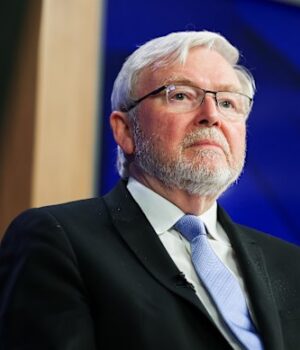
Australia risks becoming a second-rate country unless it urgently changes its national mindset, Kevin Rudd has declared as he challenges Anthony Albanese and business leaders to pursue a more ambitious policy agenda including sweeping government intervention in the economy.
The former prime minister’s dramatic appeal against complacency came as he declared there was a one-in-three chance Chinese President Xi Jinping will try to seize the self-governing island of Taiwan as soon as 2028, a move that could trigger a devastating war with the United States and Australia.
Rudd told the National Press Club in Canberra that Australians need to embrace a “radical change in our national mindset” to confront “mega-changes” that are unprecedented in modern history, including rapid advances in artificial intelligence and China’s rise to superpower status.
“We are now on borrowed time,” Rudd said in one of his most substantial interventions in the national debate since leaving parliament in 2013.
“Incrementalism will no longer work for Australia. Urgency must be our national watchword if we are to navigate our future as an independent, prosperous and resilient nation.”
The alternative, he said, is “to slide into becoming a second-rate country”.
While Rudd began his speech by declaring his remarks were not targeted at the federal government, and were directed at Australians in all leadership roles, he called for a sweeping expansion of federal industry policy across a swathe of emerging technologies.
Challenging the “self-appointed Knights Templar of economic orthodoxy” in the federal Treasury, Rudd said Japan, South Korea, Singapore and China had achieved impressive economic growth while championing national priorities such as manufacturing.
Albanese should appoint seven “industry tsars” with strong private sector experience to drive policy development and implementation in areas such as artificial intelligence, biotechnology, clean energy, critical minerals and defence, he argued.
“Each industry plan would have a tailored set of tax, regulatory policy and permitting incentives – Commonwealth, state and local,” Rudd said.
Lamenting the loss of the local car-making industry under the Abbott government, Rudd called for the Australian automotive sector to be revived, with a focus on 3D printing and electric vehicles, to “repair this fatal vulnerability in our national security”.
While praising the “intelligent framework” on AI that Albanese unveiled in July, Rudd urged the government to settle its policy quickly to ensure Australia is not left behind.
“Other countries are tailoring their own policies right now to take our place,” he said.
“We need to move with urgency to maximise the upsides and develop our own Australian AI, built on our own data, rather than making ourselves dependent on others.”
Rudd did not let business off the hook, calling for a “venture capital industry that will get off its arse” and invest in start-ups, especially in biotechnology.
The world-renowned China expert, who left his post as Australia’s ambassador to the United States in March, also called for the defence relationship with Japan to be upgraded and the government to be prepared to spend more on defence than under the current trajectory.
In a speech on Wednesday night, Rudd said there was an “increased possibility” of Xi attempting to invade Taiwan as early as 2028.
“And when I say an increased possibility, I don’t mean from 5 per cent to 10 per cent. I mean an increased possibility, which I argue is around about one in three, and I don’t use that lightly,” he said.
Rudd said the US, Australia and other allies needed to work to deter China from taking military action, including by forging ahead with the AUKUS nuclear-powered submarine pact.
The head of the Asia Society has previously raised the possibility of a 2028 Chinese invasion of Taiwan, including in a recent New York Times podcast interview with Ezra Klein, but did not put a percentage on the likelihood of the scenario.
The re-election of current Taiwanese President Lai Ching-te – whom Rudd described as “pro-independence” – could prompt Xi to take action by claiming an anti-secession law passed by China in 2005 had been breached, he said.
The US will also be in a presidential election year in 2028, possibly distracting it from events in China and Taiwan.
“Put those factors together, we just need to be mindful of an increasing level of risk, but still in the possibility stakes, not the probability stakes,” said Rudd, who turned his doctoral thesis on Xi Jinping’s political philosophy into a recent book.
“When people ask what then shall be done about this, my response is pretty simple. What’s worked since 1949 is deterrence, deterrence, and deterrence. And for those who find this some sort of ancient Cold War rhetoric, it’s not.”
It is crucial for the US to sustain its military capabilities and sense of political will that it will act to defend Taiwan, Rudd said.
 Matthew Knott is the foreign affairs and national security correspondent for The Sydney Morning Herald and The Age.Connect via X, Facebook or email.