Source : the age
Opera House Drama Theatre, September 9, until October 17.
Politics is a harsh business. As brutal as a set dominated by cold marble columns – the pillars of democracy – where a lone woman vacuums as the audience enters.
Canberra’s Parliament House has hardly been a welcoming workplace for women, as countless news stories in recent years have made clear. Why, you might wonder, would you want to work there?
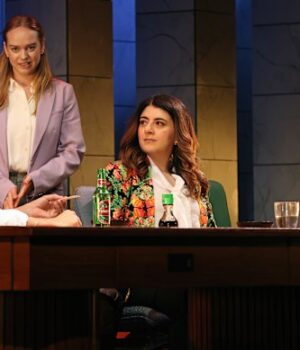
Playwright Emily Steel has taken a light-hearted approach with a satire that focuses on three women drawn to Canberra’s limelight: first-time government MP Ruth (Susie Youssef), her jaded chief-of-staff Anna (Emily Taheny) and naive junior staffer Kelly (Franca Lafosse).
Ruth is determined to make a splash with healthcare reform. Anna wants to hold together her stressful job and her unravelling home life. Starry-eyed Kelly just wants approval. She is so incompetent and lacking in initiative that it’s hard to see why she was hired.
Yet she proves pivotal. When she spends a night with the science minister, Kelly unleashes a Pandora’s box of ambition, compromises, betrayals and all-round Machiavellian behaviour.
These shenanigans become so labyrinthine in the second half that one can get lost in the maze. But it’s clear that no one emerges unscathed.
The strength of the play is that there are no black-and-white characters. All are flawed, which allows scope for ambiguity and nuance about their actions.
It’s not only male attitudes to female colleagues that are in the spotlight. Female solidarity has gone AWOL. Ruth accuses Anna of not being up to the job if she won’t sacrifice her family for it. And Anna accuses Ruth of throwing Kelly under a bus to get the science minister’s backing for the health bill.
Despite an early sight gag involving bad hair, the play relies for its comedy not on slapstick but on witty dialogue and good comic timing.
Taheny as the overburdened Anna has the lion’s share of these lines, which she delivers to incisive effect. She is the core of the play, the woman who has soldiered on even as she’s watched her dreams die. Lafosse is a spirited Kelly. Despite her implausible character, she manages to evoke sympathy as the scales fall from her starry eyes.
Youssef’s backbencher Ruth is part idealistic campaigner, part prima donna, with the dial on opening night leaning towards the latter. Indira Naidoo doubles as prime minister and a cleaner, who provides a witty analysis of what changes after an election. Johnny Nasser as the science minister gives a rounded performance of a man in crisis.
Director Shannon Rush directs with unflagging energy and draws out the comedy. Early scenes could dial back the frenetic pitch to allow pace to build. Ailsa Paterson’s set evokes the impersonal feel of parliament house, the chamber and a serviced apartment, aided by Nigel Levings’ stark lighting. Composer Andrew Howard utilises a driving percussive beat, like troops marching to war.
This is a breezy, behind-the-scenes look at the workings of political power. While it offers few fresh insights, it reinforces the adage that if you want a friend in politics, get a dog.
Opera House Concert Hall, September 4
The drawcard for this concert was to hear young pianists Lucas and Arthur Jussen – who arrived on these shores with fan base fully formed – play the classically clear, sometimes spiky lines of Poulenc’s Concerto for Two Pianos in D minor.
First, however, conductor Stéphane Denève gave the first Sydney performance of a rarity, the same composer’s coyly witty suite Les Animaux Modèles based on animal fables parodying human foibles by La Fontaine. The suite opened and closed with pastoral music of such unabashedly simple shape as to convey a sense of subtle irony, and the fables in-between, The Lion in Love, The Man with Two Mistresses, Death and the Woodcutter and The Battle of the Two Roosters, were portrayed through imaginative textures and wryly literal descriptive passages.
Poulenc’s Concerto for Two Pianos has not featured on an SSO program since the Labèque sisters played it in 1990, and the Jussen brothers launched into the neo-Baroque sequences of the first movement with the energised dynamism and immaculate ensemble playing that are their trademarks. Irony was absent, however, as they shaped the Mozartian theme and variations in the second movement with a nuanced melodic sense and persuasive expressive shape. In the quick, toccata-like finale, they tossed material back and forth to one another like superbly drilled star players. Their encore was a virtuosic display of outrageous excess, a waltz by Shostakovich arranged for two pianos by Italian pianist Igor Roma.
Enmore Theatre, September 6
A David Bowie tribute show by anyone else would make me wince. Singer/actor/writer/director John Cameron Mitchell’s song cycle specifically investigates Bowie’s darker side, which became so dominant with the Blackstar material, written when he knew he was dying.
Mitchell’s bond with Bowie runs deeper than admiration. Bowie invested in Mitchell’s Hedwig and the Angry Inch, and asked Mitchell if he’d make the album The Rise and Fall of Ziggy Stardust and the Spiders from Mars into a musical. Not interested in a jukebox show, and too shy to ask Bowie if he could tamper with the lyrics, Mitchell declined the offer, which he said was his one regret in life.
The Bowie estate should pursue the idea. Mitchell has a singular affinity for the work. His voice is not dissimilar, and he knows how to amplify the songs’ inherent drama without distorting them. Just as JoJo A. Franjoine’s astonishing lighting illuminated the stage, so Mitchell illuminated such murky recesses in Bowie’s catalogue as 1969’s Conversation Piece, as well as offering fresh perspectives on well-known songs by contextualising them with companion works about alienation, despair and destruction.
Neilson Studio, September 3, until September 20
Sydney Dance Company’s new season, Current, joins the festivities for SDC’s “40 Years at the Wharf” celebration, marking four decades in residence at its stunning overwater dance studios on Walsh Bay. Fittingly, the party stays on home ground: Current is hosted in SDC’s intimate Neilson Studio, where four contrasting works by Australian choreographers pour out across an immaculately lit island stage in one energising, hour-long program.
The opening number is artistic director Rafael Bonachela’s duet E2 7SD. Created in 2004 and named for the London postcode of his then-home, it’s an intimate portrait of a young couple’s emotional tensions, with Oswaldo Macia’s soundscape drawn from audio diaries recorded by the work’s original two dancers.
Rawer, rough-edged, and more violent than the graceful, so-fast-they-blur fluidity of Bonachela’s mature work, E2 7SD won the inaugural Place Prize for Choreography in London, the Audience Vote Award, and the New York Bloomberg Choice Award, allowing him to launch his own company with the prize money. Rewarding in its own right, it is essential viewing for Bonachela fans.
Hayes Theatre, September 2, until September 27
Don’t you hate it when the career seas seem to part for some people, and they glide from pinnacle to pinnacle, with no fear of drowning in drudgery or obscurity? J Pierrepont Finch is such a person. A window washer for a New York corporation, he reads a book called How to Succeed in Business Without Really Trying, and, following it step by step, rises inexorably to be chairman (this being the early ’60s) of the board. He also gets the girl, of course, and evades any consequences for shafting others along the way.
Stopping us from hating him are Frank Loesser’s music and lyrics, Abe Burrows, Jack Weinstock and Willie Gilbert’s book (based on a satirical manual by Shepherd Mead) and Jake Speer’s performance. Finch is both cunning and lucky, while the actor has to add the third, endearing dimension: being a goofy ingenue. So we cheer him as we might a hurdler who, with a shambling action, not only clears all the jumps, but wins the race.
When the musical first aired in 1961, it cleaned up the Tony Awards, and even won the Pulitzer Prize for drama. That, presumably, was because of the keen blade it inserts between the ribs of corporatism and capitalism. Nonetheless, the competition must have been thin because it would struggle to make many people’s top 30 musicals, and most of those didn’t win Pulitzer Prizes.
Foundry Theatre, September 2, until October 4.
Onstage at the Foundry Theatre, the intimate space tucked behind the Sydney Lyric at the Star, characters are stranded in a liminal space. Waiting for something.
Godot? No. They’re waiting for a prop shark named Bruce to stop malfunctioning so they can finish shooting a movie that has run over time and way over budget. You might have heard of it: Jaws.
This is The Shark is Broken, a gently funny and mildly philosophical take on acting, art, commerce and conflict. Written by Joseph Nixon and Ian Shaw – whose father, Robert, played shark-hunting Quint in the film – it traps us on the open water with the lead cast. Shaw (Anthony Gooley), Roy Scheider (Tom Stokes) and Richard Dreyfuss (Robin Goldsworthy) sit out passing ships and technical difficulties for weeks on end, bonds and tempers tested over and over in those tight-quartered conditions.
Opera House Concert Hall, August 31
This was more than just counting three in a bar and being careful not to step on your partner’s toes. With heads down and fingers hyperactively busy, duo pianists and brothers Lucas and Arthur Jussen drew on an invisible line of telepathic communication across the two grand pianos as they dragged and propelled the surging phrases of Ravel’s La Valse into convulsive shapes to burst into climaxes, each overreaching the one before.
Even the murky textures of Ravel’s amorphous opening had distinctive clarity and, as the piece progressed, it was as though the pair were constantly pulling the reins to restrain an emerging mood of brooding wildness. In the orchestral version of this masterpiece, Ravel’s genius lies in creating a continuous build-up of tension while always keeping something in reserve, and in the composer’s version for two pianos the Jussens sustained that arc with sinuous shades and glittering pianistic precision right up to the frenetic close.
The recital opened with the duo seated at a single piano for the simpler but nevertheless captivating gestures of Mozart’s Sonata in D major for piano, four hands, K381/123a. Its three movements progressed graciously with well-shaped phrases, nuanced contrast and impeccable ensemble playing. In Schubert’s Fantasia in F minor, D 940, also for piano, four hands, and written in the last year of that composer’s short life, they adopted a restrained tempo, unemphatic dynamics and a spacious approach that highlighted the work’s melancholy frame – although, for me, the work has even greater haunting charm if allowed slightly more forward movement.
After interval the Jussens swapped pianos for a splintering performance of Stravinsky’s two-piano version of The Rite of Spring. Conductors have been known to come unstuck attempting this work from memory but, playing without a score (as they had done for the whole program), the Jussens brewed its incantatory quiet passages and chiselled out the brittle logic of its ferocious irregular rhythms with undeviating focus.
Even with the Concert Hall packed to capacity, an encore seemed an unreasonable demand after such peaks of pianism. Nevertheless they smilingly and serenely obliged with a four-hands arrangement of Bach’s Gottes Zeit ist die allerbeste Zeit, BWV 106.
Roslyn Packer Theatre, September 1, until September 19
Before the curtain had even risen on Sydney’s opening night of the Asia Pacific tour of Heathers the Musical, the merch line was packed with fans, some already boasting thematic scrunchies and (in some cases) full Heather cosplay. After the show, the line to meet the cast at the stage door was even longer. When people love Heathers, they love it with everything they’ve got – and this production won’t disappoint them.
Based on the acerbic 1988 cult film where high school power struggles turn into murders staged as suicides, the pop-rock musical landed with buzz off-Broadway back in 2014 and was fast-tracked to Sydney in a well-received production for the Hayes Theatre. A West End cast recording and professional film capture (streaming on HBO Max), helped grow the show’s passionate fanbase. Over a decade later, it’s back off-Broadway and in Sydney too: re-imagined, re-tooled, and ready to knock your socks off.
There’s a real ease to this production. Its pacing and shape, especially in the second act, has been tightened and improved by the original creative team. The cast – all excellent – are well settled into their roles. Associate director for the Asia Pacific tour, Matt Heyward, has kept a keen eye on character and the ensemble are fully dropped-in for each scene, maintaining high school hierarchies and cliquey quirks in the background – there are so many background gags and running ‘bits’ you might not catch them all.