

Source : the age
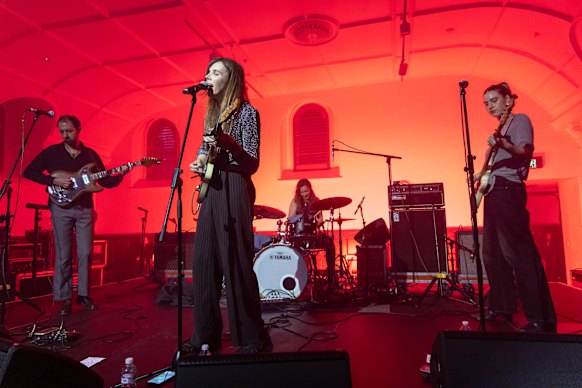
Romy Vager and her new band are on fire (figuratively speaking) in the third-floor Supper Room when the smoke alarm begins to sound at the Melbourne Town Hall.
It’s a faint whoop-whoop in the background at first, barely detectable beneath the power chords of her superb songs of failed love and self-doubt, but in the gap between tunes there’s no mistaking it. And when the security staff begin ushering the audience towards the exits, you can’t help fear that what we had assumed was the output of a hard-working smoke machine might actually be the real thing.
Thankfully, it isn’t. Some duffer has simply exited through a door they shouldn’t have, triggering the alarm system. Half an hour later, after the fire brigade has confirmed all is OK, everyone files back in for the headline acts we briefly fear we might not see.
It’s 6pm when the alarm sounds, and Rising’s festival-within-a-festival, the eight-hour, multi-venue music happening Day Tripper held on Saturday, is peaking.
It starts at midday, with Japanese outfit Hugen performing a stirring techno-folk set in the sparsely populated Main Hall. By 1pm, Adrian Sherwood is on the decks on the portico overlooking Swanston Street, turntables set up between Corinthian columns, as the sun breaks through the drizzle.
He plays a set of reggae-infused tunes for a small crowd – capped at 120 people at a time, rigorously enforced by the counter-in-hand staff on the door – who have queued to catch a glimpse of the legendary dub producer in action.
The challenge with Day Tripper, now in its third year, is working out where to be at any given moment. Twenty-six acts in six spaces – including Max Watts across Swanston and five rooms in the Town Hall – mean it’s almost impossible to catch everything. But I give it a red-hot go.
UV Race, a seven-piece formed in Gippsland, dabble in punk, electro New Wave and irony as they identify with outsiders in the short-sharp-spiky Act Like Them and rattle off the suburb names of the still-exotic city in Inner North. Jazmine Mary, representing the current crop of artists on New Zealand indie label Flying Nun, plays a kind of soulful indie folk with a tinge of jazz – courtesy of the sax and keys of her band (uniformly dressed in cream polo necks) and her own mellow guitar work – in the Supper Room.
Later, this space hosts 69-year-old Ruth Parker, a former West Australian now living in the western suburbs who released her first album in 2019 and her second, written during lockdown, last year. Her wistful, ethereal folk songs – Otherwise Occupied is a standout, with its refrain of “I need to turn the world off tonight, it doesn’t need to know that I’ve been here/If it calls me up just tell it I’m otherwise occupied” – are fleshed out with a couple of backing singers, banjo, guitar and fiddle.
She’s a gentle presence on stage, with a pork-pie hat and a speaking voice that barely rises above a whisper, but the art therapist and mental health worker is clearly relishing this late-arriving moment in the spotlight, and the audience – sitting cross-legged on the floor, listening intently – is savouring it too.
Across the hall in the Yarra Room, Ketamine Sofa could hardly be more different. A dance work from Belfast choreographer Oona Doherty, this is a simple idea stretched to breaking point and executed to perfection: in a room strewn with the litter of a house party – empties, pizza boxes, cold chips – a raver (actually a shirtless male dancer) slides slowly into the K-hole of oblivion, his body jerking and slipping in excruciating slow motion off the sofa and onto the floor as the soundtrack subsides from hard house to barely pulsing heartbeat.
Then he bounces to his feet as the yelps of school children signal the breaking of a new day. Disoriented, he stumbles out into the world, bots a ciggie, and staggers dazed and confused into whatever comes next, as the house music starts again. Rave, recover, rinse, repeat. It’s funny, a little scary, and utterly brilliant.
The genius of music curator Hayley Percy’s line-up is that it offers something for everyone while barely pandering to household names. You’re as likely to be blown away by the obscure assault of Sydney newcomers Xiao Xiao with their neo-punk psych-rock fuzz-guitar sound as you are by artists many decades, and many genres, removed.
Look closely and you can discern the threads that link Sherwood, say, to The Congos, the Jamaican reggae trio whose oldest members are 79 (and youngest 76), who play here with a seven-piece band sourced locally.
I’m not sure if there are any dots connecting either of those two to Kahil El’Zabar, but the set from the American jazz percussionist and band leader is a highlight.
Moving from thumb piano to hand percussion to drum kit to ankle bells, he leads his quartet – trumpet, sax and cello – through a set of covers that starts with a freewheeling interpretation of the old spiritual The Whole World (with him contributing vocals) and includes a movement from John Coltrane’s A Love Supreme and Miles Davis’s melodic All Blues.
Chanel Beads is the stage name of New Yorker Shane Lavers, who performs at Max Watts with a full band in tow, and has a packed room singing along to the electro-indie-pop anthem Song For the Messenger.
The headliners in the underground venue are New Zealand’s The Bats, veterans of the early days of Flying Nun and still going strong. They delight the crowd with their brand of melodic jangly indie pop, not so far removed from the stylings of contemporaries The Clean and The Chills, but still sounding fresh and relevant.
In the Town Hall, the crowd files back in after the false alarm for the main act, Kae Tempest. The English rapper, poet, playwright and novelist is preceded by a brief appearance from American spoken-word artist Saul Williams, who urges the audience to hack every perceived norm there is, and again there’s connective tissue there if you care to look for it.
Tempest is an impassioned performer whose set at times borders on a religious experience. Gripped in turn by agony and ecstasy, Tempest implores the crowd to embrace love above all else. There’s no mention of God, but it makes for a transcendent experience that leaves the crowd in rapture.
“Music is the fire,” Day Tripper had promised. “Music is the salve.”
In the end, there isn’t even smoke. But where it matters, it has delivered. Big time.
The Booklist is a weekly newsletter for book lovers from Jason Steger. Get it delivered every Friday.