Source : INDIA TODAY NEWS
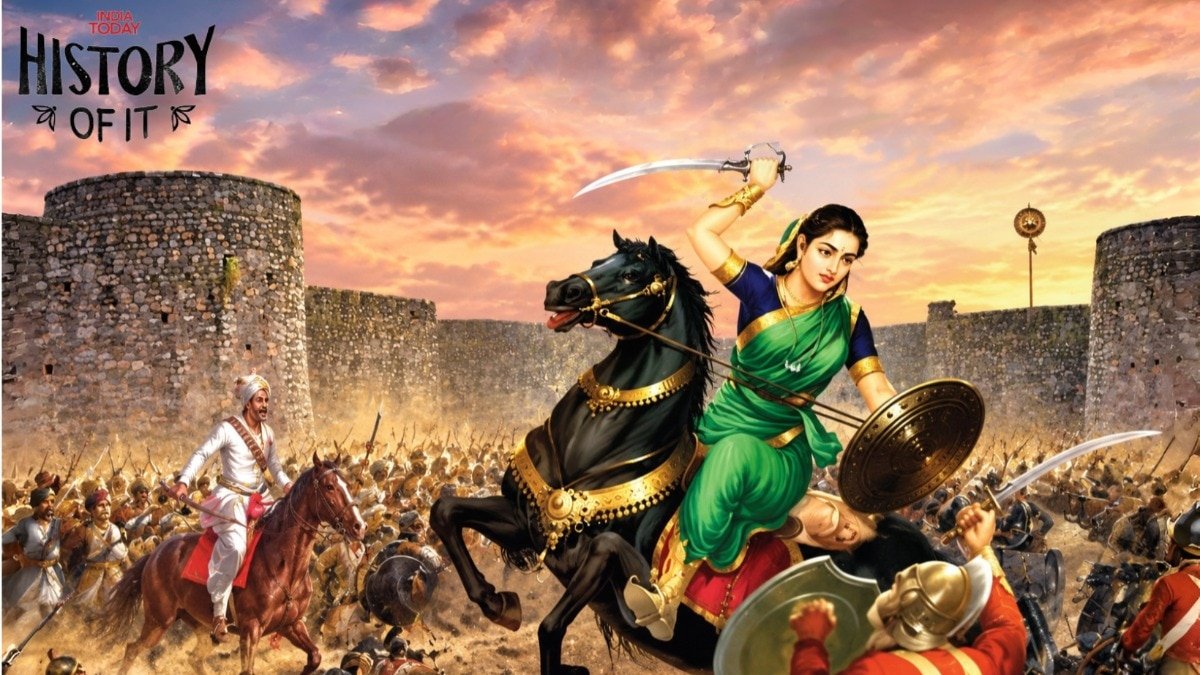
“Ride… Ride… Speed, all speed.” This was the desperate message sent by a British official from Dharwad to Belgaum (now Belagavi) on October 23, 1824. The East India Company’s political agent, St John Thackeray, had been killed. His troops were routed, and two British officers were taken prisoner. What triggered the panicked and urgent dispatch to Belgaum was a stunning defeat of the British Company troops inflicted by the forces of Rani Chennamma of Kittur, a small kingdom in the northern part of present-day Karnataka.
advertisement
The 46-year-old queen of Kittur had challenged the mighty East India Company over its refusal to recognise her kingdom’s adopted heir. Her forces defeated the British, killing their political agent and capturing two officers. But the victory was short-lived as the Company returned with reinforcements and conquered Kittur two months later in December. Chennamma, who had fought to preserve her kingdom’s sovereignty, spent her final years in captivity and died years later in 1829.
It was exactly 202 years ago on this day that Chennamma emerged victorious in one of the early armed struggles against the British East India Company’s expanding authority in the subcontinent. The Centre commemorated its bicentenary in 2024 with a special postage stamp and a commemorative coin, while a year-long programme concluded in October 2025.
Through Kittur Vijayotsava, Karnataka continues to celebrate the queen’s resistance. In January 2026, Union Minister V Somanna called for the festival to be elevated to a nationally recognised celebration, which renewed attention to the armed resistance that preceded the better-known Revolt of 1857, or the First War of Indian Independence.
While Rani Chennamma was not the first Indian ruler to resist British advances, both military and political, her victory came at a time when many Indian kingdoms were struggling to preserve their sovereignty.
Rani Velu Nachiyar of Sivaganga (in present-day Tamil Nadu) had fought British-backed forces decades earlier. The Polygars of Tamil Nadu and the Paikas of Odisha had also challenged Company authority.
Chennamma’s struggle and victory came 33 years before the Revolt of 1857, in which Rani Lakshmibai of Jhansi became an enduring symbol of resistance. Here, it must be noted that Chennamma’s war with the British over their refusal to recognise Kittur’s adopted heir preceded British Governor-General Lord Dalhousie’s formal Doctrine of Lapse policy. Under the policy (1848 to 1856), the British annexed several Indian princely states, including Satara in 1848, Jaitpur and Sambalpur in 1849, Nagpur in 1853 and Jhansi in 1854, by refusing to recognise adopted heirs or other claims of succession.
HOW A SUCCESSION DISPUTE BROUGHT THE BRITISH TO KITTUR
By the early 19th century, the East India Company had emerged as the dominant power in much of India. The Company defeated the Marathas and brought several smaller kingdoms under its influence. While some Indian territories were directly administered by the Company, others had rulers but were operated under restrictive arrangements imposed by the British. The Company maintained officials who monitored these princely states. It intervened in their affairs and sought greater control over their finances and administration. Kittur was among the kingdoms caught in this changing political order.
Kittur was a prosperous principality between present-day Belagavi and Dharwad. Agriculture, particularly the cultivation of cotton, sugarcane and food grains, and trade in agricultural produce and textiles supported its economy. Its rulers had maintained relations with the Marathas before coming under the Company’s political influence.
Following the defeat of Peshwa Baji Rao II in the Third Anglo-Maratha War (1817-1818), the British recognised Kittur’s ruling family under an arrangement that provided for hereditary succession.
Historian Queeny Pradhan, in her book, Ranis and the Raj: The Pen and the Sword, noted that the agreement required an annual payment of Rs 1.75 lakh and in return received a promise from the British that the kingdom would continue to be ruled by the royal family. Soon, Kittur faced a crisis as its ruler, Shivalingarudra Sarja, died without a biological son. Before his death, he had chosen Shivalingappa, the son of Balappagouda of Mastmaradi village and a distant relative of the royal family, as his adopted heir and successor. However, the letter informing the Company of the adoption, dated July 10, 1824, reached it only on September 12, after the ruler’s death.
The East India Company’s political agent, St John Thackeray, questioned the adoption, and asked if the letter had actually been written before the ruler died. Thackeray also questioned the authenticity of the ruler’s signature and refused to recognise Shivalingappa as Kittur’s rightful successor.
The 46-year-old Chennamma was the widow of Mallasarja, an earlier ruler of Kittur, and the stepmother of Shivalingarudra Sarja, whose death triggered the succession dispute. She emerged as the principal defender of the adopted heir, Shivalingappa, and Kittur’s succession rights. She argued that the British were violating the assurances made in 1818 following the Maratha defeat.
BRITISH COLLECTOR’S INTERVENTION ENDED IN HIS DEATH
Determined to bring Kittur under the Company’s control, Thackeray began interfering in the kingdom’s internal affairs. Historian Queeny Pradhan, in her 2022 book, wrote, “John Thackeray then proceeded to seal the royal treasury, which contained about Rs 8 or 9 lakh.”
“In another version, the sealed treasury amounted to about Rs 15 lakh. He placed his sentries to guard the treasure and the jewels,” wrote Pradhan.
He then posted British sentries and appointed two local collaborators, Konnur Malappa Setty and Haveri Venkata Rao, to guard the treasury and its jewels.
On October 20, 1824, Company troops assembled outside Kittur. Thackeray expected the show of military strength to force the kingdom’s submission. But the confrontation escalated.
Queeny Pradhan wrote that Thackeray ordered “the two guns of the horse artillery, and a company of infantry” to enter Kittur Fort, but “the people refused to admit them.” He then directed Captain Black to blow open the fort’s gates with artillery, prompting Kittur’s forces to retaliate and “open tremendous fire”.
Days later, on October 23, the British suffered a crushing setback. Pradhan wrote that Thackeray was shot while approaching Kittur Fort, “receiving a ball in his groin”. He died in the attack, along with Captain Black and Lieutenant Dighton, while Lieutenant Sewell was severely wounded.
Local tradition credits Chennamma’s bodyguard, Amatur Balappa, with shooting Thackeray. Pradhan noted that contemporary British records established his death without identifying the shooter.
Kittur’s commanders, including Guru Siddhappa, Avaradi Virappa and Amatur Balappa, played important roles in the resistance. Two British officials, JAR Stevenson and Elliot, were captured.
HOW THE DEFEAT SPARKED PANIC AMONG BRITISH OFFICIALS
News of the British defeat at Kittur, Thackeray’s death and the capture of two Company officials quickly reached the colonial administration in Dharwad and Belgaum, alarming them.
In his book Rani Chennamma, published by the National Book Trust, historian Sadashiva Shivadeva Wodeyar reproduced a desperate message sent by Dharwad Assistant Collector Walker Fullerton on October 23, 1824. He pleaded, “For God’s sake send a force immediately without delay to Kittoor.”
Reporting that the British artillery had been destroyed, Fullerton said, “Our force is no use whatever, as we only master 100 strong.”
A British military communication dated October 25, also reproduced by Wodeyar, reported the destruction of the Horse Brigade and a company of the 5th Native Infantry.
It warned of a “general insurrection throughout the country”, with Kittur’s forces reportedly patrolling the area between the Malaprabha river and Kittur, and boats sunk to obstruct troop movements. The communication also warned that the “insurgents intended to attack Dharwar, where is the Principal Collector’s treasury.”
British commanders consequently ordered reinforcements to protect Dharwad and contain the uprising.
HOW THE BRITISH RETURNED TO CONQUER KITTUR
The October victory, however, did not end the confrontation. The British demanded the release of their captured officials, Stevenson and Elliot, while Rani Chennamma sought recognition of Kittur’s adopted heir and assurances against annexation.
Negotiations continued, but the East India Company was simultaneously assembling reinforcements. Queeny Pradhan, in her book, described how British officials used the negotiations to gain time, secure their officers’ freedom and prepare another military offensive.
On December 2, 1824, Kittur released Stevenson and Elliot unconditionally, hoping to avert another confrontation. But the British did not withdraw their forces.
Instead, on December 3, troops under Colonel Deacon launched a fresh assault on Kittur Fort. The Company’s superior military strength and artillery overwhelmed the defenders, and British forces occupied the fort the following morning.
Local accounts, however, blamed Kittur’s defeat on betrayal, alleging that British collaborators had mixed cow dung with the gunpowder, which rendered the kingdom’s artillery ineffective. Pradhan noted that the account came from folk traditions and was not supported by contemporary British records, which offered no explanation for the fort’s sudden surrender.
THE QUEEN WHO WON A BATTLE BUT DIED A PRISONER
Following Kittur’s defeat, Chennamma, along with Veerawwa, the widow of Shivalingarudra Sarja, and Jankibai, the widow of Chennamma’s son, were detained in the palace for about a week. The three women were compelled to sign away their claims to Kittur before being transferred to Bailhongal Fort as political prisoners. The British fixed a combined annual pension of Rs 40,000 for them.
Sadashiva Shivadeva Wodeyar, in his book, noted that the British also dismantled parts of the royal palace and auctioned its valuable wooden structures. The queen, who continued hoping for Kittur’s liberation in captivity, died on February 2, 1829.
The resistance in Kittur survived her. Sangolli Rayanna, a loyal military leader, subsequently waged guerrilla warfare to restore Shivalingappa to Kittur’s throne. But, he was also captured and executed in 1831.
In the end, Chennamma had won a battle but lost her kingdom. And, 33 years before the Revolt of 1857, her forces had demonstrated that the mighty East India Company could be defeated.
– Ends
SOURCE :- TIMES OF INDIA