Source : PERTHNOW NEWS
Fremantle artist Kelsey Ashe is having a milestone year – literally and artistically – as she celebrates receiving two awards in a prestigious national art prize and the public reveal of her latest moonlit artworks.
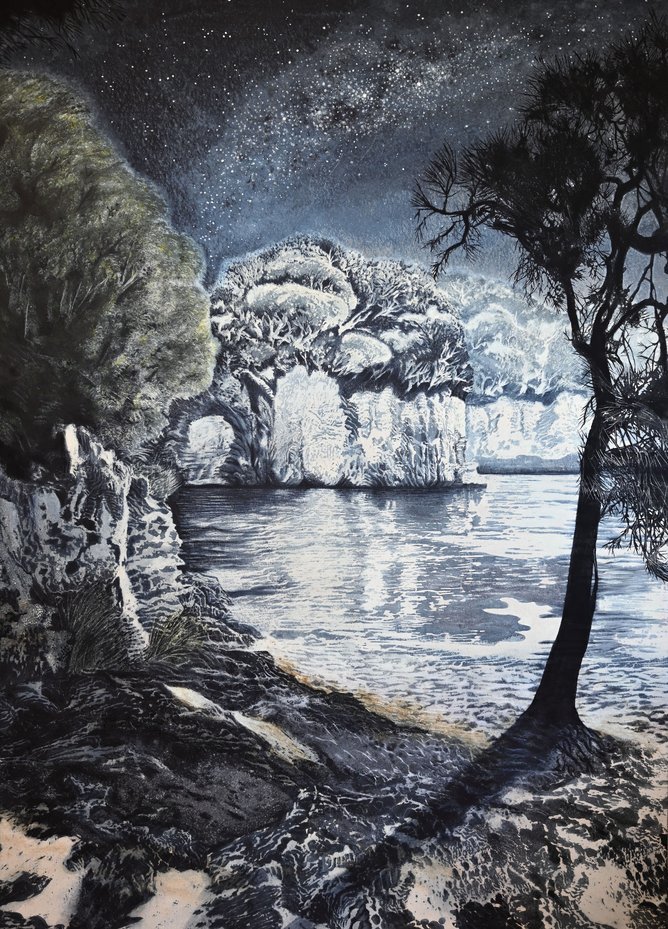
The screenprinter was selected as a finalist in Hadley’s Art Prize this year for her work Bunuru Nocturne. Its sister piece is now the signature work for her most ambition exhibition to date. The Sun at Midnight officially opens at Linton & Kay Galleries at Cottesloe tonight (Thursday, September 3).
Ashe has created 20 large-scale, highly layered wax reduction screenprints for the exhibition over the past 12 months based on a huge array of photos and drawings done at favourite places in Fremantle, Cottesloe, the Perth Hills and Albany.
They were envisioned from 12 outings she scheduled into the WA landscape that were lined up with different events on the celestial calendar, such as solstices, equinoxes, asteroids, full moons and the Venus and Jupiter conjunction.
Most were observed around East Fremantle, Fremantle and Cottesloe. Many were familiar and favourite places for family outings, but sometimes she would just head off into the environment “under my own steam”, she said.
From that rich sources of images, Ashe started exploring the mysterious space between light and shadow, “where landscape, sky, myth, cosmology and inner experience intertwine, dissolving into one another”.
“The landscape changes completely at night,” she said.
“Familiar places become mysterious. Shadows behave differently, colours dissolve, and you begin to notice things that daylight hides. My work sits somewhere between observation and imagination, where landscape, mythology and astronomy quietly converge.”
Ashe builds her intricate prints using botanical inks she makes from natural tinctures, which are photo-luminescent and glow at night-time. She uses layers of pigments, hand-cut stencils and automatic mark-making.
At tonight’s opening night, some works will be viewed under ultraviolet light to reveal the luminous layers that remain invisible during the day – inviting visitors to experience the exhibition in an entirely different way.
While screenprinting traditionally uses very exacting technique, Ashe said over her 30-year career she had deliberately moved to bring chance into her prints by disrupting the work with overprinting or by scattering pigments through it.
“It’s all made from plants and minerals and there’s a lot of texture and a lot of layers,” she said.

“The botanical inks are translucent and they build pigment and depth with each layer of screen print. Some of them have up to 20 layers. I end up with a very velvety textural surface, rather than a flat, plastic traditional screen print look.
“They are very soft and natural, so they’re lovely to live with because it’s all very non-toxic. They all have natural, muted tones.”
The Sun at Midnight explores some of WA’s most beautiful coastlines, forests, rivers and waterfalls under an extraordinary light, in a way that encourages the viewer to look out into the landscape and expand their horizon to contemplate a wider view of the Earth.
“They’re very much about Western Australian landscapes,” Ashe said.
“But also, our place on Earth and, I guess, it’s to encourage people to think of an expanded view of the landscape, rather than just saying ‘that’s a pretty landscape’ to really think about our position in the cosmo and spiralling out a little bit rather than being stuck in our little worlds.”
While she has been considering the cosmos for the past year, Ashe has also been reconsidering her place in Australia’s art world, after receiving both the IAS Art Handlers’ Award and the one-month Residency Prize for her piece Bunuru Nocturne in the 2026 Hadley’s Art Prize.

The acquisitive Australian landscape award, presented by Hadley’s Orient Hotel in Hobart, offers a $100,000 first prize. It was this year won by Robert Fielding for his artwork, Landcape, which uses the dot tradition from men’s body painting to depict wrecked cars that have made long journey’s through Country.
Ashe made her award-wining print, Bunuru Nocturne, which has now been sold, about half-way through the year. Immediately, she knew she had something beautiful to submit for the first time into Hadley’s. She had only dreamed of entering previously, saying “it’s so hard to get into”, but it has long been her benchmark for success.
“Not only did I get in – but my goodness – it won two awards. I was just so happy to be in it, and then to win, that was an amazing feeling,” she said. “I knew it was a special work, it just had something that you couldn’t put your finer on. The depths and the light – it was very beautiful.”
Rather than recreating the award-winning print for The Sun at Midnight, the exhibition has a new signature piece in a is a sister work that’s “similar but different” to Bunuru Nocturne. It was inspired by the same moonlight landscape along the banks of the Swan River.
Ashe said the piece offers an “impossible view” from popular Blackwall Reach, near Point Walter, and contains both what you can see, but also “what’s around the corner”.
“I’ve done that because I think when you’re at Blackwall Reach, you feel very enclosed and surrounded by that landscape and it’s almost like you can sense other parts around you and what is around the corner,” she said.
”I’ve tried to give the feeling of what it’s like to be there rather than what you can actually see. So it’s very immersive, it’s like you can almost step into it, you feel really surrounded by the trees and rocks.
“And it’s 2m high and 1.4m wide, so when you’re standing in front of it, it feels like you just step into it.”
The Sun at Midnight is at Ling & Kay Galleries Cottesloe Waterfront until September 27.