Source : INDIA TODAY NEWS
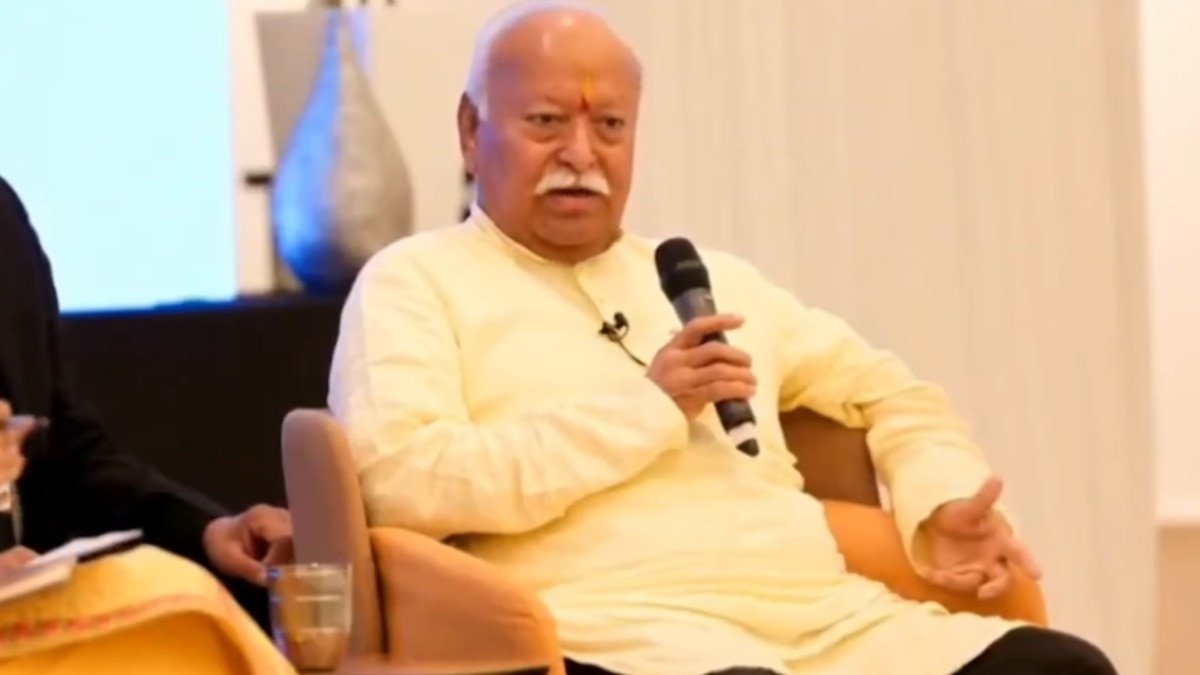
RSS chief Mohan Bhagwat on Sunday pushed back against criticism of the organisation’s ideology, saying claims that “intense hatred” lies at the heart of its work are the exact opposite of its stated philosophy. Speaking in London during the RSS’s centenary outreach, Bhagwat said RSS has instead built around “Shuddha Saatvika Prem” — pure and noble love — and a sense of “apnapan”, or belonging and oneness.
advertisement
Speaking at a civilisational dialogue in London, Bhagwat said a sense of “apnapan”, or belonging and oneness, lies at the heart of the RSS’s understanding of society.
“I heard some people say, intense hatred is the basis of our work. It is just the reverse. ‘Shuddha Saatvika Prem’, that is the basis of our work,” Bhagwat said. He said this idea of belonging stretches beyond the individual to encompass family, community, society and humanity, while also extending to nature.
“So, a Hindu is not an individual; he is family, as well as his community, as well as his society, as well as humanity. And, as all of us know, Hindus, they love nature. Not only worship, they love nature,” he said.
Bhagwat said the principle had remained central to the RSS even as the organisation marked 100 years since its founding.
“We sing a song in Sangh; we say: ‘Shuddha saatvika prem apne karya ka aadhaar hai.’ (Pure, noble love is the foundation of our work.) I heard some people say intense hatred is the basis of our work. It is just the reverse. Shuddha saatvika prem, that is the basis of our work,” he said.
“And that has not worn out even in 100 years. You will find the same shuddha saatvika love in the behaviour of swayamsevaks, in the atmosphere of the Sangh,” Bhagwat added.
MOHAN BHAGWAT’S VISION OF HINDU RASHTRA
Outlining his vision of Hindu civilisation and Hindu Rashtra, Bhagwat said the concept was based on accepting diversity while recognising an underlying unity.
“Existence is really one. It appears to be diverse. Diversities are natural. So we have to accept them; we have to respect them. But we have to deal with diversities keeping in mind that these are the various decorations of the unity of existence,” he said.
He argued that different schools of thought and forms of worship could coexist without one seeking to replace another.
“When we say Hindu, it is not a religion, it is not a worship. There may be Hindu religions… From Bharat Varsha, every kind of thought came out. From atheists to polytheists. But they all say, we have our say, but you have your say, you are also right. I tread my path; I will reach the same goal. You also come through your path, and you will reach the same goal. We need not convert each other,” he said.
On Hindu Rashtra, Bhagwat said its purpose was to communicate the idea that “diversity is a natural, unity is truth”.
‘LIVE, LET LIVE, AND MAKE OTHERS LIVE’
The RSS chief also linked the idea of unity to how societies approach conflict, development and the environment. He argued that seeing people and nature as interconnected could encourage cooperation rather than competition.
“When we think in terms of enmity, or competition, or ‘I want this, and he should not get this, I want more, and he should not get it’… If I say, ‘He needs this, I need this, we both should get this. And if I get it, I will give some of it to him,’ if we think like that, we don’t have to conquer nature; we are part of nature,” he said.
Bhagwat said development should complement environmental protection rather than undermine it.
“And when we are part of nature, our progress must add to and aid the progress of nature. Why should development and progress be at loggerheads? It should be complementary,” he said.
“So live and let live–not only that: live, let live, and make others live. That is how our thought processes evolve. So Hindus have to give this balance to the world,” Bhagwat said.
Elaborating on the centenary outreach, the London dialogue marked the final leg of Bhagwat’s three-city international programme, which began in New York and continued in Toronto. He arrived in London on September 2.
In New York on August 29, Bhagwat addressed a multi-faith leaders’ meeting attended by 175 participants and later spoke at the “Universal Oneness” conference at Madison Square Garden, which drew more than 6,000 delegates representing 250 organisations, according to the RSS. In Toronto, he addressed the “Hindu Vishwa Bandhu” conference, attended by more than 2,000 delegates from 175 organisations across Canada.
– Ends
With inputs from agencies
SOURCE :- TIMES OF INDIA